
You just spent weeks perfecting your new website. The design looks incredible, your copy is sharp, and you are finally ready to launch. But before you hit publish, you face one of the most critical decisions a digital business owner can make. You find yourself staring at a screen, overwhelmed by countless options, asking: Which Website Hosting Service is Best?
Choosing the right foundation for your digital storefront is not just a technical formality. Your host dictates how fast your pages load, how secure your customer data remains, and whether your site stays online during major traffic spikes. Make the right choice, and your website becomes a seamless revenue engine. Make the wrong choice, and you will deal with constant crashes, poor search engine rankings, and frustrated visitors.
If you want to know Which Website Hosting Service is Best for your specific goals in 2026, you need to look beyond flashy marketing banners and cheap introductory prices. You need to understand the underlying technology.
In this comprehensive guide, we will break down exactly Which Website Hosting Service is Best based on your technical needs, budget, and growth projections. We will explore the differences between shared, VPS, and dedicated environments, analyze critical performance metrics, and highlight the security features you cannot afford to ignore.
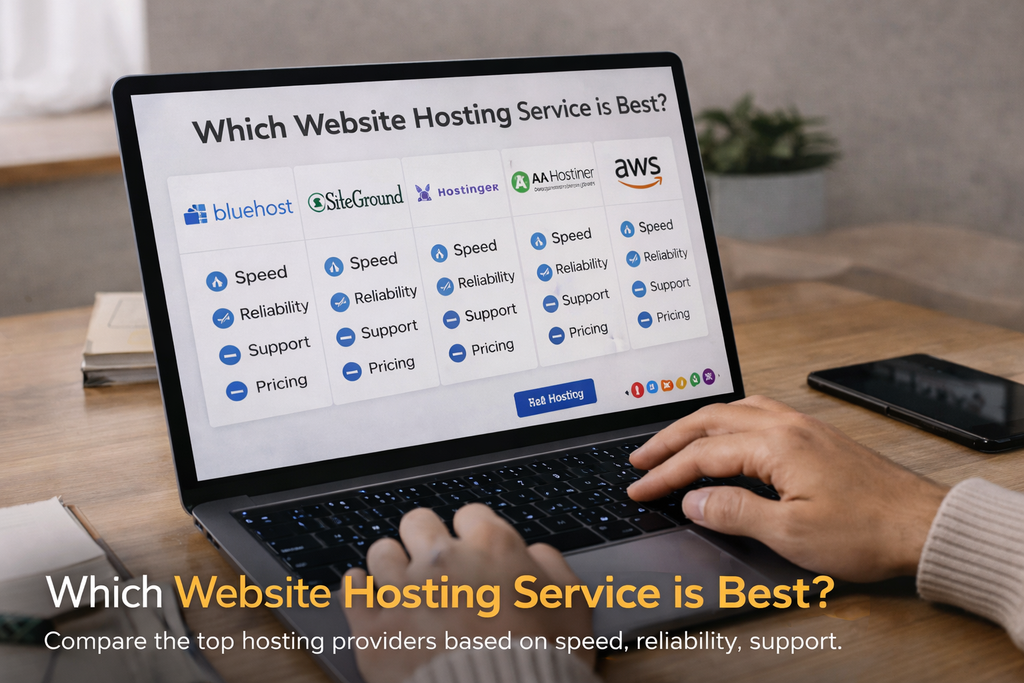
Understanding the Foundation: Types of Web Hosting
Before you can determine Which Website Hosting Service is Best, you must understand the different types of environments available. Not every business needs a massive, dedicated server. Likewise, a high-traffic e-commerce store will crash instantly on a cheap shared plan. Finding reliable web hosts means matching your current traffic levels with the appropriate infrastructure.
The Starting Point: Shared Hosting
Shared hosting is exactly what it sounds like. Your website lives on a single server alongside hundreds, sometimes thousands, of other websites. You all share the same resources, including processing power, memory, and bandwidth.
If you are launching a personal blog or a small local business site with minimal traffic, you might wonder Which Website Hosting Service is Best for a tight budget. Shared hosting is usually the answer. It is highly affordable and requires zero technical knowledge to set up.
However, shared hosting comes with significant drawbacks. If another website on your server experiences a massive surge in traffic or suffers a security breach, your website’s performance will suffer. It is the digital equivalent of living in a crowded apartment building; a noisy neighbor affects everyone.
Stepping Up: Virtual Private Server (VPS) Hosting
When your traffic outgrows a shared environment, you will likely ask Which Website Hosting Service is Best for scaling a mid-sized business. A Virtual Private Server (VPS) bridges the gap between shared and dedicated hosting.
In a VPS environment, you still share a physical server with other websites. However, the hosting provider uses virtualization technology to partition the server into isolated virtual machines. You receive a guaranteed allocation of resources. No matter what other websites on the server do, your memory and processing power remain untouched.
VPS hosting offers a massive leap in reliability and speed. It requires slightly more technical knowledge to manage, but it provides the stability growing businesses desperately need.
Maximum Power: Dedicated Hosting
Enterprise-level companies eventually ask Which Website Hosting Service is Best when money is no object and performance is paramount. The answer is dedicated hosting.
With a dedicated plan, you rent an entire physical server exclusively for your business. You do not share resources with anyone. You have complete root access, allowing you to configure the server architecture exactly to your specifications. Dedicated hosting handles massive traffic volumes and complex applications effortlessly. Unsurprisingly, it is also the most expensive option and requires a dedicated system administrator to maintain.
The Modern Solution: Cloud Hosting
Over the past few years, cloud infrastructure has revolutionized the industry. Instead of relying on a single physical server, cloud hosting pulls resources from a vast network of connected servers.
If a hardware failure occurs on one server, another server in the cluster instantly takes over. This redundancy guarantees maximum uptime. When doing a cloud hosting comparison, business owners quickly realize its primary benefit is scalability. If your website goes viral overnight, a cloud host can instantly allocate more resources to handle the surge, preventing a crash. For businesses with unpredictable traffic, deciding Which Website Hosting Service is Best often leads straight to cloud solutions.
Evaluating Performance Metrics and Speed
You cannot determine Which Website Hosting Service is Best without taking a hard look at performance metrics. Website speed directly impacts your bottom line. Research shows that if a page takes longer than three seconds to load, over half of your visitors will abandon it and click over to a competitor. Furthermore, search engines like Google actively penalize slow websites.
The Importance of Server Uptime
Server uptime is the percentage of time your website remains accessible to the public. If you want to know Which Website Hosting Service is Best, you must demand an uptime guarantee of at least 99.9%.
While 99% sounds great in theory, it actually equates to over three days of downtime per year. For an e-commerce store, three days offline means thousands of dollars in lost revenue. Top-tier reliable web hosts offer 99.99% or even 99.999% uptime guarantees, ensuring your digital doors always stay open.
Server Location and Response Time
When a user types your URL into their browser, a physical signal travels from their computer to your web server and back. The physical distance between the user and the server dictates how fast the site loads.
If you cater primarily to customers in London, but your server sits in Los Angeles, your website will experience latency. When asking Which Website Hosting Service is Best, check the provider’s data center locations. The best hosts offer multiple data centers globally and allow you to choose the facility closest to your primary audience.
Many providers also include a free Content Delivery Network (CDN). A CDN stores cached versions of your website on servers around the world, ensuring lightning-fast load times regardless of where your visitors live.
Non-Negotiable Security Features
Cyber threats evolve constantly. Hackers use automated bots to scan the internet for vulnerabilities, injecting malware and stealing customer data. When you evaluate Which Website Hosting Service is Best, security must be a primary deciding factor.
SSL Certificates and Encryption
An SSL (Secure Sockets Layer) certificate encrypts the data passing between your website and your visitors. It turns your web address from HTTP to HTTPS and displays a padlock icon in the browser.
Without an SSL certificate, browsers will flag your site as “Not Secure,” instantly destroying visitor trust. When researching Which Website Hosting Service is Best, look for providers that include free, automated SSL certificates with every plan.
Automated Backups and Restoration
Even the most secure websites can suffer catastrophic failures. An employee might accidentally delete a critical database, or a plugin update might break your entire site layout.
If you want to know Which Website Hosting Service is Best for peace of mind, check their backup policy. Reliable web hosts provide daily, automated backups and store them on a separate server. More importantly, they offer one-click restoration tools. If disaster strikes, you can roll back your website to a working version in minutes rather than days.
Malware Scanning and Firewalls
Proactive defense mechanisms keep attackers at bay. The answer to Which Website Hosting Service is Best usually involves a host that implements strict Web Application Firewalls (WAF). These firewalls monitor incoming traffic and block malicious requests before they ever reach your website. Additionally, top providers run continuous malware scans to identify and isolate compromised files immediately.
The Rise of Managed WordPress Hosting
WordPress powers over forty percent of the entire internet. Because of its massive popularity, many hosting companies now offer specialized environments optimized specifically for this content management system.
If your site runs on this platform, you will inevitably ask Which Website Hosting Service is Best: a standard shared plan or managed WordPress hosting?
Managed WordPress hosting acts as a concierge service for your website. The servers are configured explicitly to make WordPress run faster and more securely. The hosting provider handles all the tedious technical maintenance for you. They automatically update your WordPress core files, test your plugins for compatibility, and patch known security vulnerabilities.
When you wonder Which Website Hosting Service is Best for saving time, managed WordPress hosting wins easily. You do not have to worry about server caching or database optimization. You simply focus on creating great content and growing your business, while the host handles the backend heavy lifting.
The Role of Customer Support
Technology breaks. It is an unavoidable fact of digital life. When your website goes down at two in the morning on a weekend, you need immediate help.
The ultimate test of Which Website Hosting Service is Best often comes down to the quality of their customer support. A cheap hosting plan is completely useless if you have to wait three days for an email response to a critical server error.
24/7 Availability
Your website operates around the clock, and your hosting support should do the same. Look for providers that offer 24/7 support every day of the year.
Multiple Communication Channels
When a crisis occurs, you do not want to fill out a web ticket and wait. You need answers immediately. Those investigating Which Website Hosting Service is Best should prioritize hosts that offer live chat and direct phone support. Speaking directly to a knowledgeable engineer drastically reduces troubleshooting time.
Technical Expertise
Not all support teams are created equal. Some budget hosts outsource their support to entry-level representatives who can only read from basic scripts. When dealing with complex database errors or server timeouts, you need access to Tier-2 or Tier-3 system administrators. Reliable web hosts employ highly trained engineers who can identify and resolve complex issues rapidly.
Scaling for the Future
Your business will not look the same in three years as it does today. You might launch a massive new product line, run a viral marketing campaign, or expand into international markets.
Therefore, when you ask Which Website Hosting Service is Best, you must think about future scalability. Moving a large, complex website from one hosting provider to another is a stressful and risky process. You want to choose a partner you can grow with.
The ideal host offers a seamless upgrade path. You should be able to start on a basic shared or VPS plan and easily migrate to a dedicated server or cloud cluster as your traffic demands increase. They should handle the migration process internally, ensuring zero downtime while your resources expand.
Making Your Final Decision
We have covered a massive amount of technical ground. You now understand server architectures, performance benchmarks, and security protocols. So, we return to the core question: Which Website Hosting Service is Best?
The truth is, there is no single perfect host for everyone. The best service depends entirely on your specific business model.
If you are a solo blogger looking to keep costs incredibly low while you build an audience, a reputable shared hosting plan offers the best value.
If you run a growing e-commerce store where every second of downtime costs money, asking Which Website Hosting Service is Best should point you directly toward a robust VPS or scalable cloud hosting environment.
If your entire business revolves around a high-traffic WordPress site, investing in premium managed WordPress hosting will save you countless hours of technical frustration.
Stop settling for subpar performance. Do not let a slow, vulnerable server damage your brand reputation and hinder your growth. Audit your current website traffic, project your growth for the next twelve months, and evaluate your technical budget. Use the criteria in this guide to cut through the marketing noise. By taking a data-driven approach to your infrastructure, you can confidently answer Which Website Hosting Service is Best for your business and build a digital presence that thrives for years to come.