
Two companies are running ads that have the identical budget. The one burns cash and hopes for a positive outcome. While the other monitors each dollar, understands the campaigns that generate income, and gradually scales up what is successful. The main difference doesn’t lie in budget or chance. The difference is in the person.
This person is a marketing manager.
Have you ever thought about why certain teams in marketing seem to make money and others use it for their own purposes, this job lies at the root of the issue Performance Marketing Manager. It doesn’t matter if you’re an owner of a business trying to decide whether you require one, or a job seeker who’s making a job specification, or even a marketing professional aiming to earn this title, knowing the specifics of this job will save you lots of time and cash.
Let’s take a look at the job a “performance marketing manager” performs, the reason they’re important to you, and also what differentiates them from those who are just good.
What Is a Performance Marketing Manager?
The performance manager is who is responsible for generating tangible outcomes through data-driven and paid marketing channels Performance Marketing Manager. In contrast to traditional marketing professionals who concentrate on brand recognition or “getting their name known,” this role lives and dies on the numbers. Each campaign is framed by a purpose and every dollar is assigned something to do, and every outcome is assessed.
Consider them the link between marketing spending and growth of the business. They start with a budget, apply it to channels such as social media, paid search as well as display and affiliate marketing Performance Marketing Manager. They then improve it continuously until the spend transforms into sales, leads, or whatever result the company is most concerned about.
Performance Marketing vs. Traditional Marketing
The most important word is effectiveness. Traditional marketing typically asks “Did customers see our advertising?” Performance Marketing Manager “Did individuals act upon it and, if so, was it worth our investment?”
Performance marketing managers don’t have to conceal behind obscure measurements. They provide information on the cost per acquisition, returns of ad expenditure, as well as revenue. If a campaign isn’t performing then the information will show that quick, and it’s their task to correct the issue.

Core Responsibilities of a Performance Marketing Manager
The job covers a wide range of ground. However, the duties tend to be grouped around a couple of aspects. An effective performance-oriented marketing manager is able to handle each of them, without letting go of the ball.
Strategy and Planning
Prior to spending any cash There’s a strategy. A successful performance marketing director determines which channels are appropriate for the needs of their business, set achievable goals and determines which budget to divide. They research the market study competitors, conduct research, and develop a plan which connects the marketing activities to the revenue targets.
Campaign Execution
Strategies are nothing without execution. That’s why the performance marketing manager creates campaigns and runs them across different platforms. They create or supervise the ad copy, select targets, establish bids and arrange accounts in a way the data is kept clean so that the decisions are easy.
Optimization and Testing
It is at the core of this work. The campaigns rarely work in the first day. An experienced performance manager continually test headlines, the audience as well as landing pages and even the design. They eliminate what isn’t working then scale the ones that work and then tweak what doesn’t work. The cycle is never ending and that’s why this job requires perseverance and a sense of curiosity.
Reporting and Analysis
The power of numbers is when someone can explain the data. A manager who is a performance marketer transforms raw data into simple reports that the leadership team is able to take action on. They explain the things that are working, what’s not and the steps they’re planning to implement next written in plain English, rather than the jargon of.
A Day in the Life
What does a typical day’s actual work look like, from in a day to day basis? Although no two days will be similar, an average day for a marketing performance manager could comprise:
- The first step is to check the dashboards and find any campaigns that increased or slowed down overnight
- Budgets and bids that are adjusted according to the performance of the previous day’s events
- Analyzing the A/B test results, and then deciding on which one wins
- Informing the creative team about the latest ad ideas that need developing
- Sales meeting to discuss the quality of leads and closing rates.
- Investigating analytics in order to determine the reasons behind why conversion rates dropped
- Making plans for the next month’s campaign and forecasting anticipated returns
It’s a blend of hands-on, tactical work and more holistic thinking. Performance marketing professionals who are the best seamlessly switch between both by focusing on a single commercial one minute, and then moving back to think about the overall plan the next.
Essential Skills Every Performance Marketing Manager Needs
The job is in a unique crossroads. It calls for creative abilities as well as analytical rigor and business savvy all in one. The following are the abilities which are most important.
Analytical Thinking
There is no way to control the things you can’t measure and you won’t be able to make improvements on those you don’t know. An effective manager for performance must be able to swim in the data, seeing patterns, making conclusions that are reliable. The fear of numbers is the biggest obstacle here.
Channel Expertise
Each platform comes with their unique specifics. Google Ads works differently from Meta and is different than LinkedIn as well as TikTok. A skilled manager of performance marketing is knowledgeable enough about these channels to make use of each channel’s strengths, rather than using them in a similar way.
Creative Judgment
Statistics tell you what has happened However, it is the creativity that determines the next step. Ads, hooks and deals must reach out to real users. Managers who are the most effective blend the discipline of analysis with a true sense of what motivates someone to not scroll and then click.
Communication
The performance marketing director communicates with a variety of people, including executives that want outcomes, designers that require guidance, as well as sales teams that care about the quality of leads. Communicating complicated performance information clearly and convincingly is an ability which makes the difference between excellent managers from those who are average.
Adaptability
Platforms modify their regulations. The costs increase. Audiences shift. The performance marketing professional who sticks to the previous years’ strategy is to the side. Being open and curious isn’t a choice, it’s a necessity.
The Tools of the Trade
A manager of performance usually utilizes just one instrument. The tools they use typically fall into several types of categories:
- Advertising platforms include: Google Ads, Meta Ads Manager, LinkedIn Campaign Manager and more depending on the type of audience.
- Analytics Google Analytics and specific dashboards designed for each platform to track behaviour and conversions
- Tools for Attribution: Software that assists in connecting marketing touchpoints with actual sales
- Testing tools for A/B: For experimenting with landing pages, and for experimenting with imaginative
- Dashboards of reporting: Tools that combine data into easy-to-read visuals for all stakeholders.
It’s important to know the tools however understanding the best way to work using them is more. A spreadsheet doesn’t make decisions. A sharp performance marketing manager does.
The KPIs That Define Success
Each performance marketing professional adheres to a set of crucial indicators. These metrics reveal if their efforts are bringing in the money or is quietly draining budget.
Return on Ad Spend (ROAS)
It shows the amount of revenue each cent of advertising produces. This is one of the most obvious indicators of whether campaigns are successful.
Cost Per Acquisition (CPA)
What’s the price to get a brand new customer or leads? An increase in CPA is a warning sign to pay attention to something.
Conversion Rate
It’s not much if there’s no takes action. The rate of conversion tells a marketing director if the target audience as well as the message and landing page work together.
Customer Lifetime Value (LTV)
The smartest managers think beyond just the first sales. A comparison of LTV with acquisition costs reveals whether the entire engine is long-lasting or has run out of fuel.
How a Performance Marketing Manager Impacts ROI and Growth
This is where the job is rewarded for its success. A competent performer marketing manager has a direct impact on the business’s bottom line with a degree that no other position are able to match.
In cutting down on wasted spending by reducing wasteful spending, they can free up funds for the channels that perform. Through improving the conversion rate, they can squeeze greater profits from the same amount of traffic. When they scale winning campaigns with care and carefully, they can boost results without blowing budgets.
Take a look at a basic illustration. The company spends $500,000 a month on advertisements without a clear plan of action, producing 200 leads. An experienced performance marketing manager comes in, chops off the dead ads, improves their targeting and enhances the page of landing. A few months later, that same $50,000 is generating 350 leads. There was no change to the budget. The entire plan was the same.
This is the type of effect that transforms marketing from a cost into an engine for growth.
Working With Sales and Creative Teams
A performance marketing manager cannot do it on their own. This job is heavily dependent on an effective collaboration with the entire company.
Partnering With Sales
Leads only have value if they’re closed. Any performance marketing manager who doesn’t pay attention to feedback from sales is at risk of producing a lot of leads which don’t get any use. The most successful ones remain within close contact with sales and learn the types of leads that convert, and then feed that information back into the targeting. This process improves performance over time.
Collaborating With Creative
Great creative drives great performance. The performance marketing manager collaborates closely with both copywriters and designers to share what research indicates about the visuals and messages are most effective. The partnership helps keep creativity grounded with results, while making room for new thoughts.
If these partnerships are successful when these relationships are successful, the entire marketing process gets more effective and efficient.
Hiring Considerations: What to Look For
If you’re bringing on someone to manage your performance marketing department The temptation is to be focused on certifications of platforms. These are important, but insufficient by themselves.
You should look for a person who can clearly explain their reasoning, rather than just talk about metrics. Discuss how they’ve transformed a failed campaign to a successful one performance marketing manager. Pay attention to curiosity, openness about their failures, and also for their ability to tie marketing activities to the business’s results.
Unsuspecting? One who talks for hours about their activities (“we conducted 40 marketing campaigns”) however they are unable to link it back to the outcomes (“which produced X the revenue”). A good performance marketing leader constantly returns to the impact.
Common Mistakes to Avoid
Many talented individuals make mistakes. Understanding the most common mistakes can help those in charge and also the individuals who employ them.
Chasing Vanity Metrics
Feel good when you click and see your impressions however they don’t make a difference in the bottom line. The performance manager who focuses on these rather than of revenue will be measuring incorrect things.
Scaling Too Fast
An advertising campaign that is effective with $100 per day may not be successful at all times if it’s $1,000 a day. Spending money on a winning campaign in a hurry can sabotage the effectiveness of a campaign. It is important to be patient.
Ignoring the Funnel
Traffic is just one aspect of the game. If the landing page, or product isn’t strong enough and not optimized, then no amount of targeted advertising will be able to save it. An experienced performance marketing manager monitors the entire process, not just the ads.
Set-and-Forget Campaigns
Performance marketing isn’t just a slow cooker. Unchecked campaigns can drift into waste, wasting money, and can even degrade. Continuous attention is a part of the package.
Career Growth for a Performance Marketing Manager
If you’re a professional who is considering this route there is good news the need for them is always expanding. Since more companies are tying budgets for marketing to tangible outcomes, the importance of a well-trained marketer who can perform well only increases.
The progression of a career usually takes place from specialist jobs to the managerial position, later up to head-of performance or senior posts performance marketing manager. Certain individuals advance to broader management of marketing as director or vice president. Some go on to work for themselves, providing consulting to multiple firms or creating businesses on their own.
The abilities you acquire through this position, including analysis, budgeting and revenue-focused thinking, are transferable to nearly every job in marketing that is senior performance marketing manager. Very few positions teach you to link your everyday decisions with the business goals as clearly as this position.
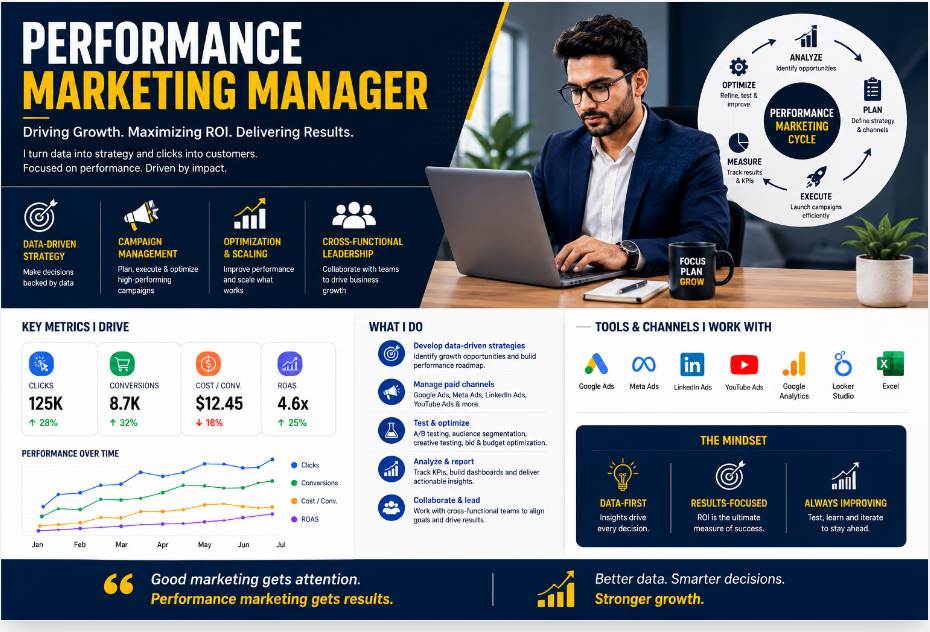
What Separates a Great Performance Marketing Manager From an Average One
A lot of people make advertisements. However, very few are able to execute them effectively. What’s the distinction?
An average performance marketing manager campaigns. The best ones manage outcomes. A typical one will report figures. The most effective one will explain the significance of those numbers and the best way to handle the numbers. A typical person follows the best methods. The most successful one can tell how to fix the rules.
The top performers in this field have a unique combination of skills that is: they are analytical and not robot-like, innovative but not reckless, and they’re confident, but not rigid. They view the budget as if they’re their own. They don’t stop asking whether there’s a better method to achieve result.
The mindset of this person, above any certification or tool will make the high-performance marketing manager truly worthwhile.
The Bottom Line
The term “performance marketing manager” doesn’t mean simply someone who is running advertisements. They’re the ones who turn marketing spending into quantifiable increase, connects innovative concepts to actual revenue and holds every penny responsible performance marketing manager. If you’re a business that is serious about growing effectively, this job is among the most effective decisions you can make.
Perhaps you’re hiring one or cooperating with one or even becoming one, the lesson is exactly the same. Be aware of the bigger picture and pay attention to the reasoning behind the ideas behind them. In the end, an effective performance marketing professional does not just spend the budget. They increase it.
Frequently Asked Questions
What can a performance-marketing manager accomplish?
A manager of performance plans to run, optimizes, and runs targeted marketing campaigns based on data that span paid media to achieve tangible results. They concentrate on metrics such as ROI on advertising spend and cost per acquisition and conversions performance marketing manager. They continue to modify campaigns in order to increase these numbers to boost business growth.
What kind of skills will a marketing manager require?
The job demands a combination of the ability to think critically, channel-specific expertise on platforms such as Google and Meta and Meta, creative judgement clarity in communication and flexibility. The ability to work with data and the ability to tie the marketing activities to revenues are essential.
How does performance marketing differ than traditional marketing?
Traditional marketing is often focused on brand recognition and exposure and performance marketing is focused on quantifiable actions and the return on the investment. Performance marketing manager track each dollar spent and evaluates performance based on tangible results such as sales leads or leads and not just impressions.
What performance-related KPIs should a marketing manager keep track of?
The most significant ones are the return on advertising spend (ROAS) and cost per acquisition (CPA) and conversion rate and the customer’s life-time value (LTV). These measures show whether the campaigns yield a profit and are sustainable in the long run.
Are performance-based marketing managers suitable for small company?
Often, yes. Even the smallest ad budget could be wasted if it is not managed with an expert supervision. An experienced performance marketing manager can reduce wasted spending increase conversions and extend the budget even farther, making his or her job worth the cost often.