
Years ago, many taxi companies could rely on phone calls, local word of mouth, and a dispatcher with a busy line. That model still exists, but it no longer carries the business on its own. Riders now expect speed, visibility, instant booking, and digital trust. They want to know the fare before they ride, track the car on a map, pay online, and get updates without calling anyone. Drivers expect better tools too. Owners want tighter control, better reporting, and smoother operations across the board.
That shift is why a website for taxi business is no longer just a digital brochure. It is a working part of the business. In many cases, it is the front desk, the booking counter, the marketing engine, and the operations layer all at once.
This guide explains what makes a modern website for taxi business effective. You will learn which features matter most, how the right tech stack supports growth, why UX decisions affect bookings, how monetization works, and how local SEO helps taxi brands win in their own service areas. If you want to build a platform that does more than look good, this is where to start.
Why a Taxi Website Has Become a Core Business Asset
A modern taxi company competes on convenience as much as price. If your website is slow, unclear, or outdated, customers often assume your service will feel the same. That means your website for taxi business shapes trust before a ride ever begins.
More importantly, a strong website for taxi business supports real operations. It helps customers book rides, helps drivers manage trips, and helps admins control pricing, service areas, and performance. It becomes part of how the company runs day to day.
This is where many competitors still fall short. They treat the website as a marketing page with a contact form. But the stronger model is different. A serious website for taxi business works like an online cab platform, connecting customer demand with supply, payments, and service management in one system.
That difference matters because the taxi market is now shaped by digital expectations. A rider who can book food, buy tickets, and reserve a hotel room in seconds will expect the same ease when booking a cab. If your company cannot provide that, another one will.
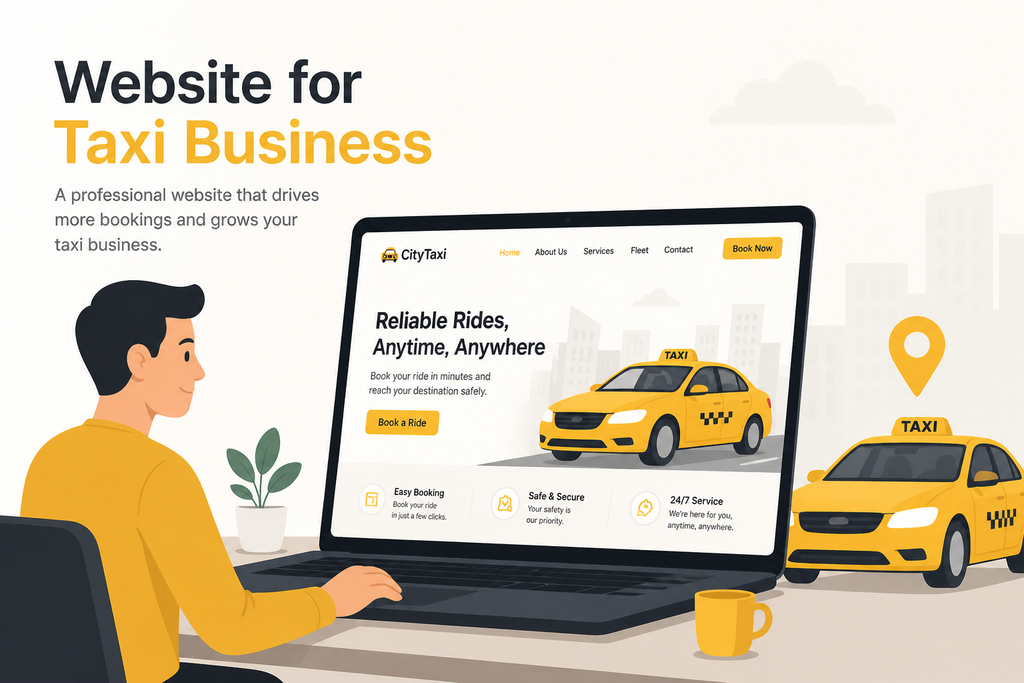
What a High-Performing Taxi Website Should Actually Do
The best website for taxi business does not just attract traffic. It converts traffic into bookings and turns bookings into repeat customers.
At a practical level, your platform should help with:
- Customer acquisition
- Ride booking
- Driver coordination
- Payment collection
- Support handling
- Reporting and decision-making
That is why a modern website for taxi business needs to function like a lightweight ride-hailing software system rather than a static site. It should reduce manual work, speed up booking flow, and give both riders and operators better visibility.
A smart site also supports growth. As your business adds vehicles, drivers, routes, or cities, the platform should scale with you. This is especially important for companies that plan to expand from a local service into a wider online cab platform.
Essential Features for Riders
The rider side is where first impressions are made. If the customer journey feels hard, your conversion rate drops fast. A successful website for taxi business should make booking feel simple, fast, and trustworthy.
Easy sign-up and login
Users should be able to register with email, phone number, or social login. OTP verification can improve trust and reduce fake accounts. A smooth sign-up process keeps users moving instead of making them stop.
Fast booking flow
The booking process is the heart of any website for taxi business. Riders should be able to enter pickup and drop-off points, choose a vehicle type, view an estimated fare, and confirm the ride quickly. Too many steps create friction.
Clear fare estimates
Price transparency matters. Customers do not like surprises. A visible fare estimate, even if it is approximate, can increase trust and reduce booking abandonment.
Real-time tracking
A modern website for taxi business should allow riders to track the assigned driver in real time. This is a standard expectation now, not a premium add-on. It lowers anxiety and cuts support calls.
Multiple payment options
Cash, cards, wallets, and region-specific payment methods all matter depending on your market. Payment flexibility improves conversion and user satisfaction.
Ride history and receipts
Customers want access to past rides, invoices, and booking details. This is especially useful for business travelers and repeat users.
Ratings and reviews
Feedback tools help maintain service quality. They also give your operations team insight into driver performance and customer issues.
Scheduled ride booking
Many users need airport rides, office commutes, or early morning pickups planned in advance. A strong website for taxi business should support instant and scheduled bookings.
All of these features shape passenger UX. When passenger UX is strong, users feel in control. That leads to more trust, better retention, and fewer drop-offs in the booking funnel.
Essential Features for Drivers
A taxi operation only works when drivers can use the system easily. Yet many companies still underinvest in the driver side. That is a mistake because a weak driver experience harms service quality fast.
A capable website for taxi business should support drivers with practical tools, not cluttered dashboards.
Driver onboarding
Drivers should be able to register, upload documents, and submit vehicle details through a clean process. This saves time and helps the admin team review new applications more efficiently.
Availability controls
Drivers need a simple way to go online and offline. This small feature is vital because it affects supply visibility and ride assignment.
Ride request management
A good website for taxi business should let drivers receive, accept, or reject ride requests quickly. Delays here affect wait time and customer trust.
Navigation and route support
Integrated maps and route guidance help drivers reach pickup points faster and reduce confusion during active rides.
Earnings dashboard
Drivers want transparency. Showing trip earnings, incentives, deductions, and payout details helps build trust with your supply side.
Trip history
Trip records support accountability, dispute handling, and performance reviews.
Strong driver tools also connect directly to fleet management. Even if you do not operate a large fleet, visibility into driver activity, availability, and trip flow helps the business run more smoothly.
Essential Features for Admins
The admin side often decides whether a taxi website becomes useful or chaotic. A strong website for taxi business needs a control center that supports growth, service quality, and day-to-day management.
User and driver management
Admins should be able to approve, suspend, edit, and review accounts on both sides of the marketplace.
Booking oversight
A smart website for taxi business gives admins live visibility into active, completed, canceled, and disputed rides. This helps support teams act faster when problems happen.
Pricing and commission settings
Your system should allow you to update base fares, service charges, surge pricing rules, and commissions without needing a developer every time.
Zone and service area control
For local and regional taxi companies, service boundaries matter. Admins should be able to define areas, airport routes, premium zones, and restricted locations.
Analytics and reporting
A high-value website for taxi business provides data on bookings, revenue, repeat customers, cancellation rates, and driver performance. These insights support better decisions over time.
Promotions and offers
Promo codes, discounts, and referral campaigns can help attract users and boost repeat bookings.
Support and dispute resolution
Your admin panel should support customer complaints, driver issues, refunds, and booking exceptions in one place.
This is where fleet management also becomes more strategic. With the right dashboard, admins can monitor vehicle usage, driver status, and operational gaps without relying on manual calls and spreadsheets.
The Right Tech Stack for a Modern Taxi Platform
Technology choices affect performance, cost, scalability, and maintenance. If you want a durable website for taxi business, you need a stack that can handle live bookings, map activity, user accounts, and payments without slowing down.
Why React works well on the frontend
React is a strong choice for the frontend because it supports fast, dynamic interfaces. Taxi websites need responsive forms, live updates, map interactions, and reusable UI components. React handles those well.
A React-based website for taxi business can deliver a smoother booking flow, quicker screen updates, and a more app-like feel on the web. That supports stronger passenger UX and better overall usability.
Why Node.js is a smart backend choice
Node.js fits well because taxi platforms depend on real-time events. Booking confirmations, driver assignment, status changes, and notifications all happen quickly and often at the same time.
A Node.js-powered website for taxi business can support these live interactions efficiently. It also works well for event-driven systems, which makes it a natural fit for ride-hailing software behavior.
Databases and infrastructure
PostgreSQL and MySQL are common choices for handling structured data such as users, rides, payments, and service zones. Cloud hosting on AWS, Google Cloud, or Azure helps support scaling.
For a growing website for taxi business, infrastructure should allow for:
- Secure user authentication
- Real-time data handling
- High uptime
- Flexible API integrations
- Room for future expansion
Maps, notifications, and payments
No serious website for taxi business can function without third-party integrations. You will likely need:
- Map APIs for location and routes
- Payment gateways for online transactions
- SMS or push notification services
- Email systems for receipts and confirmations
These systems come together around your booking engine, which is the functional core of the platform. The booking engine handles ride requests, fare flow, trip creation, and status changes from start to finish.
UX/UI Best Practices That Improve Bookings
Plenty of taxi websites have features. Fewer have a good experience. That is where UX and UI make the difference.
A high-performing website for taxi business should reduce user effort at every step.
Put booking first
Users come to book, not to admire a homepage banner. The booking form or booking button should be visible early and clearly.
Keep forms short
Only ask for what is needed. Long forms make a simple ride feel like paperwork.
Use plain language
Terms like “Pickup,” “Drop-off,” “Ride Type,” and “Estimated Fare” are easier to understand than vague labels. Clear wording improves passenger UX.
Design for mobile first
Most taxi users book on phones. Your website for taxi business should load quickly, use large tap targets, and keep navigation simple on smaller screens.
Show trust signals clearly
Ratings, safety details, secure payment messaging, and company contact information should be easy to find. Trust is part of the design.
Provide status visibility
People want updates. A strong interface should show when a ride is confirmed, when a driver is assigned, and when the vehicle is arriving.
These details may seem small, but they have a large effect on conversion. Good design reduces stress. In transport, reduced stress often leads directly to more bookings.
Automated Dispatch and Operational Efficiency
As taxi businesses grow, manual trip assignment becomes harder to manage. That is where automated dispatch changes the game.
A smart website for taxi business should support automated dispatch based on rules like:
- Driver proximity
- Vehicle type
- Driver availability
- Service zone
- Current traffic conditions
With automated dispatch, the system can match riders and drivers faster than a human team working by phone. It improves response time, cuts delays, and helps use driver supply more efficiently.
This also improves fleet management, especially for operators with multiple vehicles or wider service areas. Better assignment logic means fewer missed rides, lower idle time, and a more reliable customer experience.
In practice, automated dispatch turns a taxi website into a stronger operational platform. It is one of the clearest ways a digital system moves beyond being just a marketing asset.
Monetization Models That Make Sense
A strong website for taxi business should support revenue, not just bookings. Monetization needs to be built into the platform structure from the beginning.
Commission per ride
This is common in marketplace models. The platform takes a percentage of each completed booking.
Driver subscriptions
Some businesses charge drivers a weekly or monthly fee for access to leads and platform tools.
Surge pricing
Higher demand periods can support higher fares if handled clearly and fairly.
Corporate accounts
Business travel is often a strong revenue channel. A professional website for taxi business can support scheduled bookings, monthly billing, and invoicing for company clients.
Premium ride categories
Luxury, airport, or executive ride options can raise order value.
Cancellation fees
These protect driver time and help reduce misuse of the system.
The best monetization model depends on your market and business type. But the key point is simple: a strong website for taxi business should make revenue pathways easier to manage, not harder.
Local SEO: How Taxi Websites Win Nearby Searches
Local SEO is one of the biggest growth levers for a taxi company. Most customers search based on place and need. They look for airport taxis, local cab booking, city rides, or 24/7 taxi services near them.
A strong website for taxi business should be built to capture that intent.
Create location-focused pages
Build pages for cities, neighborhoods, and common routes if they matter to your service. These should be useful and specific, not copy-paste filler.
Optimize metadata and headings
Use relevant keywords naturally in titles, H1s, meta descriptions, and content. This helps search engines understand what your website for taxi business offers and where.
Support Google Business Profile consistency
Your business name, address, phone number, and service information should match across your website and listings.
Add local trust content
Customer reviews, city-specific FAQs, airport route details, and service guarantees all help improve local relevance.