
The global logistics boom has completely changed how businesses and consumers move goods. With e-commerce sales reaching record highs, people expect their packages delivered faster, safer, and with total transparency. If your delivery business still relies on phone calls and manual spreadsheets, you are losing money to competitors who operate online. You need a digital storefront that works around the clock. Learning how to create a courier service website is the single most profitable step you can take to capture this surging demand.
Your website is not just a digital business card. It is a dispatch center, a customer service representative, and a sales machine rolled into one. Customers want to open their laptops, get a quote, book a pickup, and track their parcels without speaking to a single human being. By mastering how to create a courier service website, you build a powerful asset that automates these tasks and scales your operations.
This guide dives deep into the technical and strategic needs of a delivery business. We will explore niche selection, essential technical infrastructure, core features, and user experience design. You will also learn the precise SEO strategies needed to dominate your local market. Let us explore exactly how to create a courier service website that outranks your competitors and drives consistent revenue.
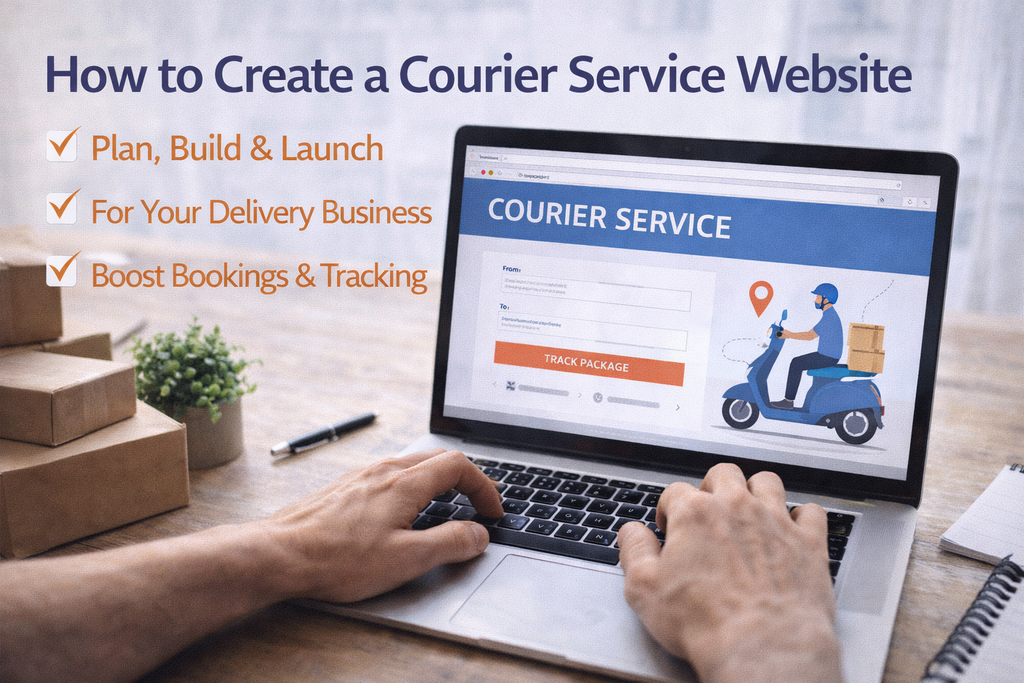
Why You Need a Digital Storefront in the Logistics Boom
Consumer expectations have shifted dramatically. We order groceries on our phones and track our rideshares on a map. This expectation now applies directly to the shipping and logistics industry. Whether you are running a fleet of box trucks or a local bicycle messenger service, your clients expect a frictionless digital experience.
When you research how to create a courier service website, you quickly realize that the goal is to remove friction. Corporate clients and everyday consumers alike want predictability. A poorly designed site, or no site at all, signals to potential clients that your actual delivery operations might be just as unorganized.
Understanding how to create a courier service website properly means understanding trust. You are asking people to hand over valuable items, sensitive documents, or expensive merchandise. A professional, feature-rich digital storefront builds that necessary trust instantly. It shows you use modern courier dispatch software and take your business seriously.
Step 1: Niche Selection for Your Delivery Business
Before you look at domain names or hosting plans, you must define what you are actually delivering and who you are delivering it for. A generic delivery company struggles to stand out. Niche selection dictates the entire structure of your platform. When figuring out how to create a courier service website, your target market influences every design and technical decision.
Medical and Healthcare Courier Services
If you transport medical specimens, lab results, or pharmaceuticals, your site must project extreme security and reliability. Learning how to create a courier service website for the medical field means highlighting HIPAA compliance and secure chain-of-custody protocols. Your imagery should be clean, clinical, and professional.
B2B and Legal Document Delivery
Law firms, accounting agencies, and corporate offices need highly reliable, same-day document delivery. If this is your niche, your site must focus heavily on speed and confidentiality. When planning how to create a courier service website for B2B clients, prioritize a streamlined corporate account creation process.
E-commerce and Last-Mile Delivery
Retailers need partners to handle the final leg of their delivery process. This niche requires robust technical integration. Your site needs to speak directly to warehouse managers and retail owners, offering bulk delivery platform development capabilities and API access to connect directly to their online stores.
Step 2: Laying the Technical Infrastructure
The backbone of your operation relies on solid technology. You cannot afford downtime when clients are frantically trying to locate a time-sensitive package. Understanding how to create a courier service website requires making smart choices about your technical foundation.
Start with a highly memorable domain name. Keep it short, avoid numbers, and try to include a word that indicates speed or delivery. Once you have your domain, secure premium cloud hosting. Shared hosting often leads to slow page load speeds, which drives users away. For a high-traffic logistics business, invest in managed hosting that guarantees 99.9% uptime.
Next, choose your Content Management System (CMS). While DIY builders are fine for local bakeries, delivery platform development usually requires more horsepower. WordPress is highly recommended because it offers immense flexibility. You can integrate advanced logistics plugins and scale the system as your fleet grows. If you plan to build a massive, complex infrastructure, you might eventually need a custom-built web application using frameworks like React or Node.js.
No matter which CMS you choose, security is non-negotiable. You will collect physical addresses, phone numbers, and payment details. Ensure your site has an active SSL certificate, robust firewalls, and regular automated backups. A core rule of how to create a courier service website is to protect client data relentlessly.
Step 3: Must-Have Logistics Website Features
A successful digital presence in the logistics space requires specific functional elements. Clients visit your page to perform actions, not just read about your history. When you dive into the mechanics of how to create a courier service website, you must include these core logistics website features.
Automated Price Calculators
Nobody wants to call a phone number just to find out how much a delivery costs. You need a dynamic quoting engine prominently displayed on your homepage. The calculator should allow users to input the pickup zip code, the delivery zip code, and the dimensions or weight of the package.
The system should instantly calculate the distance and provide clear pricing options based on speed. For example, show distinct prices for a two-hour rush, a same-day delivery, and a standard next-day drop-off. Providing instant quotes is a crucial element when learning how to create a courier service website.
Online Booking and Scheduling
Once the user sees the price, they must be able to book the delivery immediately. Build a clean, multi-step booking form. Collect the exact pickup location, delivery instructions, and contact information for the recipient.
Integrate a secure payment gateway like Stripe or PayPal so the customer can pay upfront. For your regular corporate clients, offer an invoicing option or a pre-funded digital wallet. Mastering how to create a courier service website means making the transaction as smooth as buying a cup of coffee.
Real-Time Tracking Integration
This is arguably the most important feature you can offer. Package anxiety is a real phenomenon. Clients want to know exactly where their items are at any given moment. Proper real-time tracking integration sets you apart from amateur operations.
Assign a unique tracking number to every order. Create a dedicated tracking portal on your site where clients can enter that number. The portal should pull data directly from your drivers’ courier dispatch software, showing milestones like “Driver Dispatched,” “Package Picked Up,” and “Delivered.” The best systems even show the driver’s current location on a live map.
Client Account Dashboards
Frequent shippers need a centralized hub. Build a secure login area where returning clients can view their order history, manage their saved addresses, and download monthly invoices. A robust account dashboard encourages repeat business and builds brand loyalty. Including a dashboard is a vital step when exploring how to create a courier service website that retains customers.
Step 4: UX/UI Best Practices for Logistics
Even the most advanced technology fails if the user cannot figure out how to use it. User experience (UX) and user interface (UI) design dictate how easily visitors navigate your digital storefront.
When you learn how to create a courier service website, you learn that clarity beats creativity. Your homepage should not feature abstract art or confusing navigation menus. Use a clean, modern design with ample white space. Use high-contrast colors for your primary buttons, ensuring they stand out immediately.
Your primary calls to action (CTAs) should be “Get a Quote” and “Track a Package.” These two buttons must be visible above the fold on every single page. Do not make users hunt for the core functions of your business.
Mobile responsiveness is another critical UX factor. Many of your clients will need to book a rush delivery while standing in a warehouse or riding in a cab. If your pricing calculator breaks on an iPhone screen, you lose that client forever. Every step in the process of how to create a courier service website must be tested extensively on mobile devices. Ensure buttons are large enough to tap and text is easily readable without zooming in.
Step 5: SEO Strategies for Local Delivery Services
Building a functional platform is only half the battle. If potential clients search for a “same day delivery near me” and your competitors show up instead, your beautiful site is useless. Search engine optimization (SEO) is what brings the right traffic to your doorstep.
Executing how to create a courier service website successfully requires a hyper-local SEO strategy. Start by claiming and optimizing your Google Business Profile. Ensure your company name, address, and phone number perfectly match the details on your site. Encourage your satisfied clients to leave positive reviews on Google, as this heavily influences local search rankings.
Next, build dedicated location pages. If you service three distinct counties or major cities, do not lump them all onto one generic page. Create a specific page for each area. For example, build a page titled “Same Day Courier Services in Chicago” and another for “Medical Delivery in Evanston.” This strategy signals to search engines exactly where you operate.
Fill your site with highly relevant content. Write blog posts answering common customer questions. Discuss topics like packaging fragile items securely, the benefits of local outsourced logistics, or how weather impacts delivery times. Consistently adding fresh, informative content builds your authority and shows Google that your site is active. A major part of how to create a courier service website is transforming it into an industry resource.
Finally, ensure your on-page technical SEO is flawless. Use descriptive, keyword-rich title tags and meta descriptions for every page. Compress your images so your site loads lightning fast. Search engines penalize slow websites heavily.
Building a Scalable Operations Hub
Your digital storefront connects directly to your physical operations. As order volume increases, the line between your website and your internal management software blurs.
This is where advanced courier dispatch software comes into play. When a client books an order on your site, the information should flow automatically to your dispatch dashboard. The system should then route the delivery to the nearest available driver based on GPS data. Mastering how to create a courier service website means creating a seamless loop between the client, the dispatcher, and the driver.
By integrating these systems, you eliminate data entry errors and reduce the time it takes to execute a delivery. This efficiency allows you to scale your business rapidly without hiring massive teams of administrative staff.
Bringing It All Together
The logistics industry rewards speed, precision, and reliability. Your digital presence must reflect these exact qualities. Shifting away from manual booking processes to an automated digital environment unlocks serious revenue potential and builds tremendous operational value.
You now possess the exact blueprint on how to create a courier service website from the ground up. Start by clearly defining your specific niche and target audience. Invest in a rock-solid technical infrastructure that can handle spikes in traffic. Focus intensely on core logistics website features like automated pricing, real-time tracking integration, and simple booking forms.
Pay close attention to your mobile design, ensuring users can navigate your platform effortlessly from any device. Finally, implement aggressive local SEO tactics so you capture the high-intent traffic actively searching for delivery solutions in your area.
When you fully understand how to create a courier service website, you build more than just web pages. You build a scalable, automated engine that works tirelessly to generate leads, close sales, and manage your fleet. Stop letting lucrative delivery contracts slip away to your competitors. Take control of your digital storefront today and establish your business as the premier logistics provider in your market.