
You don’t need thousands of dollars to launch a profitable Google Ads campaign. That myth keeps countless small business owners on the sidelines while their competitors scoop up clicks. The truth is more flexible — and far more encouraging.
Google sets no fixed floor on what you must spend. You can start with $5 a day or $5,000 a month, and the platform will happily take either. But “what Google allows” and “what actually works” are two different questions. Spend too little and your campaign starves before it can learn. Spend without a plan and you burn cash on clicks that never convert.
This guide breaks down exactly what the google ads minimum budget means in practice, how much you should set aside based on your goals, and how to make every dollar count.
In this article, you’ll learn:
- What the google ads minimum budget actually is (and the number Google won’t tell you directly)
- How daily and monthly budgets work, including the surprising overspend rule
- Recommended starting budgets for Search, Display, Shopping, and other campaign types
- The real factors that decide how much you need to spend
- Practical tactics to stretch a tight budget without wasting clicks
Let’s get into it.
What Is the Google Ads Minimum Budget?
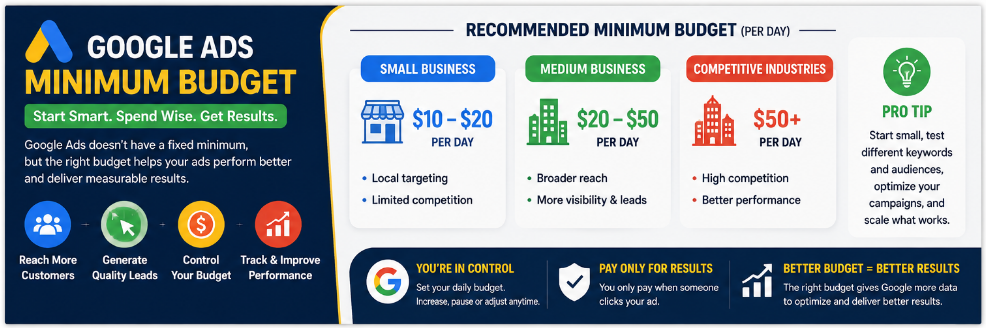
Here’s the honest answer: there is no official google ads minimum budget. Google does not require you to commit to a set amount before you launch. You enter a daily budget, set your bids, and the auction does the rest.
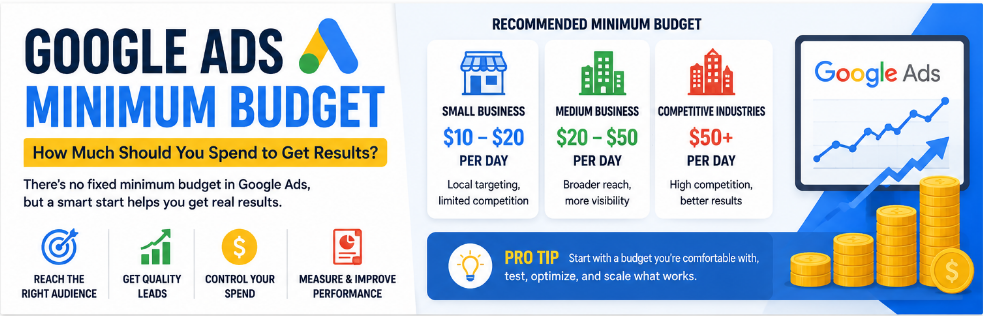
That said, a functional minimum exists — the point below which your campaign can’t gather enough data to perform. For most small advertisers, that practical floor sits around $10 to $20 per day, or roughly $300 to $600 per month.
Why does the practical minimum matter more than the technical one? Because Google Ads relies on volume to learn. Its algorithms need clicks and conversions to optimize bidding, targeting, and ad delivery. Set your spend too low and the system never collects enough signals to improve. You end up paying for clicks without the learning that turns those clicks into customers.
So when people ask about the google ads minimum budget, they’re really asking two things: What will Google accept? and What will actually get results? The first is nearly zero. The second depends on your industry, goals, and competition — which we’ll cover next.
How Google Ads Budgeting Works
Before you pick a number, you need to understand how Google spends your money. Two concepts matter most: the daily budget and the monthly cap.
Daily Budget vs. Monthly Budget
You set your spend at the campaign level using a daily budget. This is the average amount you’re willing to spend each day. Google then multiplies that figure by the average number of days in a month (30.4) to calculate your monthly spending limit.
For example:
- Daily budget of $20 → monthly limit of about $608
- Daily budget of $50 → monthly limit of about $1,520
Simple math. But there’s a twist most beginners miss.
The Overspend Rule
Google may spend up to twice your daily budget on any given day. If you set $20 a day and the demand is high, Google might spend $40 on a Tuesday to capture extra opportunities.
Don’t panic — this evens out. On slow days, Google spends less. Across the full billing period, you will never be charged more than your daily budget multiplied by 30.4. The daily fluctuation simply lets Google chase high-value moments without blowing your monthly google ads minimum budget.
Knowing this rule prevents the classic mistake: seeing a single high-spend day, assuming you’ve lost control, and pausing a campaign that was actually working fine.
Recommended Minimum Budgets by Campaign Type
Not all campaigns cost the same. A Search ad targeting a competitive keyword behaves very differently from a Display banner. Here’s a realistic breakdown of where your google ads minimum budget should land depending on what you run.
Search Campaigns
Search is where intent lives. People type a query, and your ad appears with an answer. Because these users are actively looking, clicks tend to convert well — but they also cost more in competitive niches.
A workable google ads minimum budget for Search starts at $15 to $30 per day. In low-competition local markets, you can succeed on the lower end. In legal, insurance, or finance niches where a single click can cost $20 or more, you’ll need significantly higher spend to gather meaningful data.
Display Campaigns
Display ads show up across millions of websites, apps, and videos. Clicks are far cheaper — often a few cents each — but conversion rates are lower because you’re reaching people who aren’t actively searching.
You can run a Display campaign on as little as $5 to $15 per day. The cheap traffic makes Display a budget-friendly entry point, though it works best for brand awareness and retargeting rather than direct sales.
Shopping Campaigns
For e-commerce, Shopping ads put your products front and center with images and prices. They convert strongly because shoppers see exactly what they’re getting before they click.
Plan for a google ads minimum budget of $20 to $40 per day here. Product feeds need volume to optimize, and you’ll want enough spread across your catalog to identify which items perform.
Performance Max Campaigns
Performance Max blends Search, Display, Shopping, YouTube, and more into one automated campaign. Because it spans so many channels, it’s hungry for budget and data.
Google’s automation needs room to breathe. A practical floor for Performance Max is $50 to $100 per day. Anything less and the algorithm struggles to test across all those placements effectively.
Video Campaigns
YouTube ads charge mostly per view, which keeps costs low. You can launch a video campaign on $10 to $20 per day, making it accessible for awareness goals on a modest budget.
When we line these figures up side by side, the differences become obvious:
| Campaign Type | Recommended Minimum Budget (Daily) | Best For |
|---|---|---|
| Search | $15–$30 | High-intent leads and sales |
| Display | $5–$15 | Brand awareness and retargeting |
| Shopping | $20–$40 | E-commerce product sales |
| Performance Max | $50–$100 | Full-funnel automated reach |
| Video (YouTube) | $10–$20 | Awareness and engagement |
Use this table as a starting point, not a rulebook. Your actual google ads minimum budget will flex based on the factors below.
Recommended Budgets by Business Type
A solo plumber and a national retailer face very different math. Here’s how spending tends to break down across business sizes.
Local Small Businesses
If you serve a single city or region, you’re competing in a smaller pool. A google ads minimum budget of $300 to $750 per month often delivers steady leads for service businesses like dentists, contractors, or salons. Tight geographic targeting keeps waste low.
Growing E-Commerce Stores
Online stores need more room to test products and audiences. Budget $1,000 to $3,000 per month to gather enough conversion data across your catalog and identify your winners.
Mid-Sized Companies
Businesses targeting multiple regions or product lines should plan for $3,000 to $10,000 per month. This range supports several campaign types running at once with enough data in each.
Competitive or National Brands
In crowded industries — finance, SaaS, legal — expect to invest $10,000+ per month just to stay visible. High click costs eat budgets fast, and a thin google ads minimum budget simply won’t register against deep-pocketed rivals.
Factors That Affect How Much Budget You Need
Two businesses in the same city can need wildly different budgets. These variables explain why.
Cost Per Click in Your Industry
Average CPC ranges from a few cents to $50 or more depending on your niche. Insurance and legal keywords sit at the high end. Hobbies and local services sit much lower. The higher your CPC, the larger your google ads minimum budget must be to collect a usable number of clicks.
Your Conversion Rate
If your landing page converts 2% of visitors and you need 20 sales to test a campaign, you need 1,000 clicks. Multiply that by your CPC and you have your real budget requirement. A higher conversion rate stretches the same dollars further.
Geographic Targeting
Targeting a single zip code costs far less than targeting an entire country. Narrowing your radius is one of the fastest ways to make a small budget feel bigger.
Competition and Bidding
When more advertisers chase the same keywords, the auction heats up and CPCs climb. Seasonal spikes — think holidays or tax season — can double costs overnight. Watch your industry’s rhythm and adjust.
Campaign Goals
Brand awareness on Display is cheap. Direct sales on competitive Search keywords are not. Your objective directly shapes how much you’ll spend per result, and therefore your google ads minimum budget.
How to Stretch a Small Google Ads Budget
A tight budget isn’t a death sentence. Smart structure beats raw spend more often than people expect. Here’s how to get more from less.
Target Long-Tail Keywords
Broad keywords like “shoes” cost a fortune and attract unfocused traffic. Long-tail phrases like “waterproof hiking shoes for women” cost less, face less competition, and pull in buyers who know what they want. They’re a cornerstone of any lean google ads minimum budget strategy.
Use Tight Geographic Targeting
Don’t pay for clicks in places you can’t serve. If your business operates within 15 miles, set your radius to 15 miles. Every dollar then goes toward reachable customers.
Add Negative Keywords
Negative keywords stop your ads from showing on irrelevant searches. Block terms like “free,” “jobs,” or “cheap” if they don’t fit your offer. This single habit can slash wasted spend dramatically.
Schedule Ads for Peak Hours
If your conversions cluster between 9 a.m. and 6 p.m., don’t run ads at 3 a.m. Ad scheduling — also called dayparting — concentrates your budget when buyers are active.
Improve Your Quality Score
Google rewards relevant, well-built ads with lower costs. A strong Quality Score means you pay less per click than competitors for the same position. Tighten the match between your keywords, ad copy, and landing page to climb the score and stretch your google ads minimum budget.
Focus on One Campaign at a Time
Spreading $300 across five campaigns gives each one too little to learn Google Ads Minimum Budget. Pour that same budget into a single, focused campaign and you’ll gather data faster and reach profitability sooner.
Optimize Your Landing Pages
The cheapest way to improve ROI isn’t in Google Ads at all — it’s on your website. A landing page that converts 5% instead of 2% effectively cuts your cost per sale by more than half. Fix the page before you raise the budget.
Common Mistakes Advertisers Make With Low Budgets
Knowing the pitfalls is half the battle. These mistakes drain small budgets the fastest.
Spreading Too Thin
The number one killer of small campaigns. When you split a modest google ads minimum budget across too many keywords, campaigns, and locations, nothing gets enough data to optimize. Concentrate your fire.
Giving Up Too Soon
Campaigns need time to exit the “learning phase.” Pausing after three days because you haven’t seen a sale wastes the data you’ve paid to collect. Give automated bidding at least two to three weeks before judging results.
Using Broad Match Without Guardrails
Broad match keywords can match your ad to loosely related searches Google Ads Minimum Budget. Without negative keywords to fence them in, they devour budgets fast. On a small budget, lean toward phrase or exact match until you have data.
Ignoring Conversion Tracking
If you can’t measure conversions, you’re flying blind. You’ll never know which keywords make money and which waste it. Set up conversion tracking before you spend a single dollar — it’s free and essential.
Setting and Forgetting
Google Ads is not a slow cooker. Budgets, bids, and competition shift constantly. Check in weekly, prune underperformers, and reinvest in winners. Neglect costs money.
Chasing Vanity Metrics
Impressions and clicks feel good but don’t pay the bills. A campaign with fewer clicks and more conversions beats one with thousands of clicks and zero sales. Always tie your google ads minimum budget back to revenue, not noise.
How to Set Your Own Starting Budget
Ready to pick a number? Work backward from a goal instead of guessing.
- Find your target — how many leads or sales do you want per month?
- Check your conversion rate — or estimate 2–3% if you’re new.
- Calculate clicks needed — divide your target by your conversion rate.
- Multiply by your industry CPC — use Google’s Keyword Planner for estimates.
- Divide by 30.4 — that’s your daily budget.
For example, if you want 10 sales, convert at 2%, and your CPC is $2, you need 500 clicks, or $1,000 a month — about $33 a day. That math gives you a grounded google ads minimum budget rather than a hopeful one.
Start there, run for three weeks, then adjust based on real data. Scale up what works and cut what doesn’t.
Conclusion: Start Small, Spend Smart
The google ads minimum budget you actually need depends on your industry, goals, and how well you build your campaigns — not on some universal number. Google lets you start with almost nothing, but smart advertisers aim for enough spend to gather real data: typically $10 to $30 a day for Search, more for Shopping and Performance Max.
The advertisers who win on small budgets aren’t the ones who spend the most Google Ads Minimum Budget. They’re the ones who focus tightly, track everything, and improve relentlessly.
Your action plan:
- Calculate your budget using the backward-math method above — start with what your goals demand, not what feels comfortable.
- Pick one campaign type that matches your objective and pour your budget into it.
- Set up conversion tracking before you launch so every dollar is measurable.
- Use long-tail keywords and negative keywords to keep waste low from day one.
- Give it three weeks, then review the data and scale your winners.
A modest google ads minimum budget can absolutely deliver results. Start lean, watch the numbers, and let proven performance — not guesswork — guide every increase.