
You’ve heard them hundreds of times. On sales calls or on LinkedIn and in sales pitches from agencies that promise you the world. So you invest. You run campaigns. You create websites, share on social media and maybe enhance a few advertisements. But when someone asks if your marketing strategy is “working,” you pause. You’re not sure of exactly what’s happening or if it’s worth it.
This confusion is extremely frequent. The debate over digital marketing vs performance marketing is a source of confusion for intelligent, competent business owners each and every day. Both terms sound alike. They have tools in common. They constantly overlap. However, they are pulling towards different goals and mixing them in a quiet way can cost your time, money and also growth.
This guide helps clear the confusion. We’ll clarify the meaning behind each and where they intersect, and the ways they differ between goals channels KPIs, budgeting and timeframes Digital marketing vs Performance marketing. Additionally, you’ll discover which one to put first or the other and how to mix them to get the most effective results.
Here’s a short roadmap:
- What does digital marketing cover?
- What does performance marketing really mean?
- The two overlap, and also where they divide
- What to look for, as well as common myths and errors
Let’s get this settled one and for all time.
What Is Digital Marketing, Really?
Digital marketing falls under the biggest umbrella. It encompasses every marketing activity that takes place online, complete stop Digital marketing vs Performance marketing. Search engine optimization and Content Marketing as well as social media marketing email, your site as well as paid search displays video, influencer relationships It all is covered in this one roof.
The goal is not just limited. Digital marketing vs Performance marketing increases visibility, creates perception creates connections, strengthens relationships and helps keep your brand visible throughout the various channels that your target customers use. Some of it leads to direct sales. A lot of it doesn’t necessarily, or at least not immediately.
Imagine brand marketing in this way. A carefully written blog or an informative Instagram reel, or a professional website that is well-crafted and earns trust. These aren’t always the trigger for an immediate purchase. They are a way to get people excited. They make you more familiar as well as trustworthy, which is worthy of remembering when the purchasing moment arrives.
This is what drives digital marketing: long-term visibility and connectivity across the digital world. It’s a long-term and multiplication game.
What Is Performance Marketing, Really?
Performance marketing is a specific part of that umbrella. It’s digital marketing that has the aid of a stopwatch and calculator in the Digital marketing vs Performance marketing. Every action is tied to the measurement of a specific outcome and the cost is usually according to the results you get: leads, clicks, installations or sales.
This is where the measurable ROI is the guiding principle for all marketing. Performance marketing takes place in paid media as well as paid search, conversion-focused ads, and firmly monitored funnels. The main thing is accountability Digital marketing vs Performance marketing. When you spend a rupee you’re hoping to see how this rupee will bring back.
A well-designed Digital marketing vs Performance marketing plan is one that focuses on the numbers that most people ignore costs per lead or cost per acquisition return on investment, as well as conversion rates. It heavily relies on tracking conversions, which means any decision relies on facts rather than the gut instinct.
In essence the Digital marketing vs Performance marketing process, it answers an unambiguous question: did this marketing campaign generate revenue? If it’s not able to demonstrate that it has a return, it’s removed. This discipline is precisely the reason it is so effective.
Digital Marketing vs Performance Marketing: The Core Difference
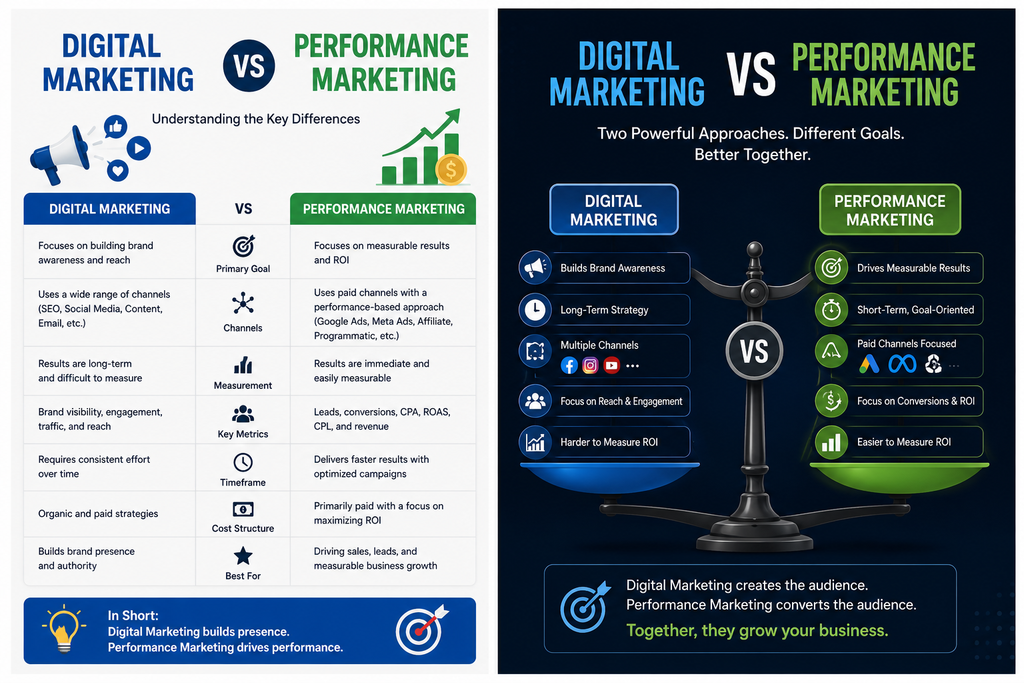
This is the easiest method to comprehend the distinction between performance marketing and digital marketing. Marketing through digital channels is about the where, the how as well as the where. Performance marketing explains reason as well as what it costs..
Digital marketing is the whole toolset of digital channels. The concept of Digital marketing vs Performance marketing is results-driven method that employs certain tools, with a an uncompromising focus on the outcomes. Therefore, performance marketing is an element of digital marketing and is not a competitor to it.
This one insight changes the entire digital marketing vs performance marketing debate. They’re not enemies. One is the classification and the other is a way to be accountable for engaging within it. When you realize the difference, deciding between them is much simpler.
However, the differences in practice are significant. Let’s take them apart in a way that is clear.
How They Differ Across Goals, Channels, and Metrics
If you contrast performance marketing and digital marketing side-by-side and the contrasts are sharp and beneficial.
Goals
Digital marketing aims to create a mixture of engagement, awareness, trust as well as sales that grow over the course of time. Performance marketing is chasing only one thing: a particular and measurable event, often an order or lead today.
Channels
Digital marketing is a broad term that covers Content marketing and SEO organic social media marketing, email public relations, as well as paid advertisements. Performance marketing focuses on channels where the results are scalable and trackable mostly targeted campaigns for conversion on social media platforms, and Retargeting.
KPIs
Digital marketing is the place where and performance marketing really splits. Digital marketing could track followers, reach and engagement, as well as traffic in addition to brand awareness. Performance marketing monitors the cost per lead and conversion rate, returns on advertising spend and the cost of customer acquisition. One measure attention, the other measures the amount of money.
Budgeting
Digital marketing budgets typically function as fixed investment. They are committed to content, design and even presence, regardless of the immediate results Digital marketing vs Performance marketing. The budgets for performance marketing fluctuate constantly. The money you invest in the areas that convert and eliminate those that don’t, often in that same day.
Timelines
Digital marketing, particularly SEO and content, play the long-term game. The results will build over time. Digital marketing vs Performance marketing delivers faster signals. You can start paid media campaigns right now and access meaningful data in a matter of days.
The way these distinctions are presented in a way can make the performance marketing decision more concrete.
Where the Two Overlap
In spite of their differences, there is a huge overlap and to ignore it would be an error.
Both are live on the internet. Both depend on knowing your customers. Both employ creative copywriting or landing pages. A successful paid search ad requires strong messaging which is a Digital marketing vs Performance marketing expertise. The best content is able to benefit from conversion tracking which is a performance-based marketing practice.
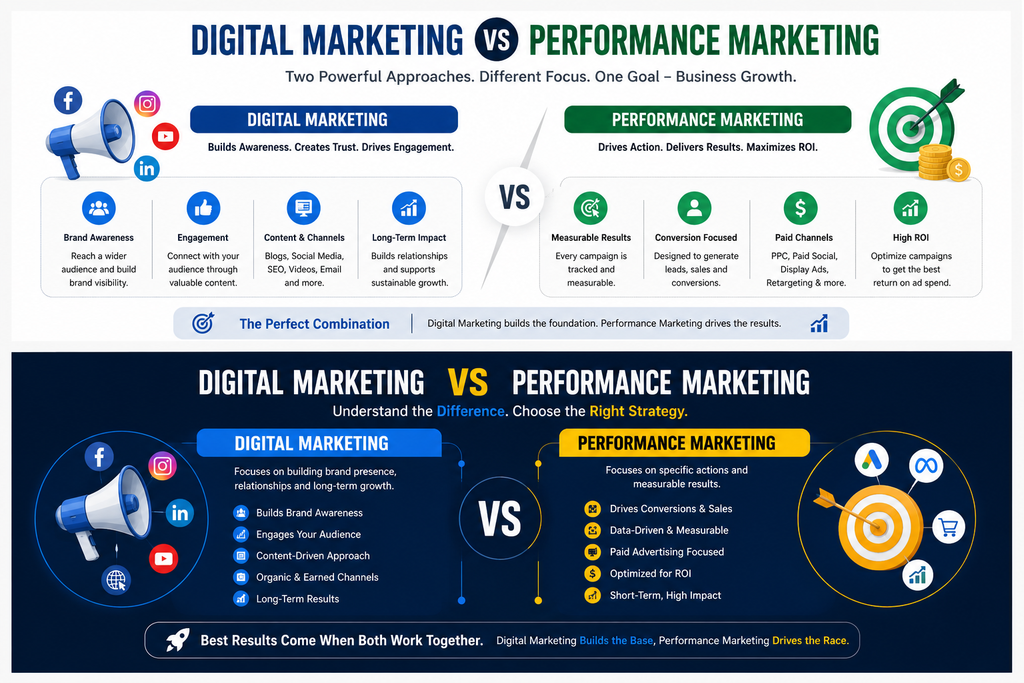
The marketing funnel joins them all together in a neat way. Digital marketing typically is at the top, generating the brand’s awareness and creating interest through marketing and content as well as social media reach. Performance marketing has the upper hand by capturing interest and turning it into sales through conversion-focused marketing.
Therefore, the digital marketing vs. performance marketing issue isn’t resolved with a single choice. The most effective brands combine both, and let each do the best job it can across the funnel.
When to Prioritize Digital Marketing
Sometimes, a broader approach to digital marketing can be more beneficial. Here’s when.
Make sure you choose digital marketing first when you’re constructing your brand starting from scratch and want to be recognized prior to anyone searching for your name. If your product is in need of education content, social media and content take on the bulk of the work. If you’re in a relation-driven business where trust is a matter of time and patience, the patient brand marketing pay off.
It is also a winner in the event that your budget is low however you are able to invest in sweat equity. Content marketing and SEO take more time and effort than cash and will continue to be effective for a long time after you have published. The exposure you earn becomes an asset that you own, not just rented attention that you lose when you stop spending.
In these instances the digital marketing vs performance balance of marketing is tilted towards the more long-term, compounding game.
When to Prioritize Performance Marketing
In other instances performance marketing can be the one to lead. Here’s when.
Consider performance marketing first when you require more leads or to increase sales right now rather than within six months. If you’ve already established your offer but need to increase the quantity, you can use paid media to can be scaled quickly Digital marketing vs Performance marketing. If you are able to clearly determine the value of a client and perform marketing, you can buy them with confidence and profitably.
It’s also perfect when cash flow relies on winnings that are quick. A start-up that needs to demonstrate the ability to grow, an online store that clears inventory, or any service company that has open calendar slots are all benefited by the efficiency and reliability of conversion-oriented campaigns.
In this case, the digital marketing vs. performance marketing decision is in the direction of the immediate, measurable acquisition of customers.
Why Combining Both Beats Choosing One
Most agencies can’t declare in plain terms: the performance vs. digital marketing debate is usually an untrue decision. The most effective growth is achieved by merging both.
Imagine it all working together. Your social media presence and your content increase trust and build make audiences warm. Your Digital marketing vs Performance marketing will then be able to capture this heightened demand at the lower end of the funnel, effectively converting it. Branding can make your advertisements less expensive because you have people who are familiar with your brand engage and convert at greater rates. The data on performance will reveal which types of messages are popular, and sharpens your digital marketing strategy.
Feedback loops are the winning. The idea of treating digital marketing vs performance marketing as an alliance instead of being a competition is exactly the way that serious brands create growth engines for marketing that multiply.
Each side is able to cover the weaknesses of the other. Digital marketing without performance isn’t able to provide accountability. Marketing without performance is lacking an underlying. Together, they’re formidable.
Common Myths About Digital Marketing vs Performance Marketing
Many misconceptions cloud this issue. Let’s eliminate the biggest ones.
Myth 1: They’re Completely Different Things
They’re not incompatible. Performance marketing is part of the realm of digital marketing. The digital marketing vs. performance marketing issue in terms of “either/or” misses how connected the two are.
Myth 2: Performance Marketing Is Always Better Because It’s Measurable
It’s not a guarantee that you will be able to measure it as superior. Digital marketing vs Performance marketing can capture existing demand well, but isn’t able to generate demand from scratch. Without brand marketing fueling it, even brilliant campaigns reach a limit.
Myth 3: Digital Marketing Can’t Be Measured
False. Digital marketing today tracks a lot of things, from engagement to traffic as well as assisted conversions. It’s not as direct as the ROI calculations of Digital marketing vs Performance marketing.
Myth 4: You Must Pick One
The most harmful myth. The most effective strategies integrate both of them across the funnel of marketing.
Mistakes Businesses Make When Choosing
Even the most skilled owners get caught in this area. Keep an eye out for these.
The pursuit of only produces short-term results. Pouring everything into performance marketing and ignoring branding work, you are with a vacancy of attention that lasts forever. When you stop paying, leads disappear.
Doing away with tracking completely. Running paid media campaigns that don’t have proper conversion tracking is like driving with blindfolds on. It’s impossible to optimize what you can’t measure.
Expecting immediate search engine optimization results. Treating SEO and content marketing as performance channels will set you up for failure. They build slowly, and then quickly.
Don’t be fooled by the digital marketing vs. performance balance in your marketing. A brand-new company in desperate need of cash flow should not put all its efforts into slow branding. A well-established brand shouldn’t overlook the long-term benefits that content offers.
copying your competitors’ work blindly. Their digital marketing mix is suited to their goals margins, stage, and goals but however, not always yours.
By avoiding these, you can keep your money working to be in the right place.
A Simple Framework for Deciding
Unsure of where to start? Utilize these quick checkpoints.
- Want results in a hurry and you have a proven offering? Prioritize performance marketing.
- Gaining recognition in a competitive or trust-laden industry? Lead with digital marketing.
- Do you have a steady budget with perseverance? Invest in both from the beginning.
- Are you strapped for cash but still rich over time? Start with SEO and content marketing. Then, you can layer on paid advertising after you’ve collected information.
The truthful answer to the question of Digital marketing vs Performance marketing is generally “both, in the right proportion for your stage.” Make sure you have the right ratio and you’ll stop being a the result of a guess.
Frequently Asked Questions
What’s the most simple distinction between performance and digital marketing?Digital marketing is the broadest of all marketing that is online. It is also a result-driven part of it. You spend money and evaluate specific outcomes, such as results or sales. Therefore, performance marketing is a part of the realm of digital marketing.
Does performance-based marketing a part of marketing via digital?
Yes. In the digital marketing vs performance marketing comparison, performance marketing is a subset, a focused, accountability-driven way of using certain digital channels with measurable ROI as the goal.
Which is the cheapest?
It depends. Performance marketing is a continuous ads, but they show clearly the benefits. Content marketing and SEO will cost more time and effort at the beginning, however they continue to deliver value at no cost in the long term. The cost of SEO and content marketing is not the same for everyone.
Can small businesses do either?
Absolutely. A lot of companies start with lean performance marketing to generate leads quickly as they build digital marketing assets such as social media and content. The mix of marketing tools changes as the business expands.
What is the best way to determine the success of every case?
Digital marketing is based on the ability to reach and engagement, traffic, and recall of the brand. Performance marketing is based on lead cost and conversion rate, as well as return on investment as well as the cost to acquire customers. Select KPIs that align with the objective.
Do I need to switch from digital towards performance-based marketing?
Rarely, it’s an either/or. In lieu of changing, you can rebalance. The best mix of digital marketing vs. performance marketing split will depend on your goals, your budget and the speed at which you require revenues.
The Bottom Line: Stop Choosing, Start Combining
The whole digital marketing vs. performance marketing debate is a distant memory once you realize the larger picture. One creates trust and presence with time. The other is more dependable and has proven its value today. It’s not necessary to pick either side, but instead you have to weigh these two.
The most successful businesses employ branding-building digital marketing in order to create funnels and precise performance marketing to turn it, while letting each one feed each feed. This is how you can earn recognition as well as the ability to measure growth rather than trading one thing for the other.
This is the next step. Take a look at your current stage as well as your budget and the speed you’ll need results. Create a strategy that assigns each strategy the right place in. Find the digital marketing vs performance marketing balance just right and your marketing begins to take on its own weight and turning your marketing dollars into leads, visibility and actual revenue.
Are you ready to create a more effective growth strategy that combines with the very best? That’s the exact kind of clarity your next chapter needs.