
It’s budget planning season. The CFO wants to know exactly how every dollar converts to revenue this quarter. Your CEO, meanwhile, just got back from a conference convinced the company needs a “bigger brand presence.” And you’re stuck in the middle, holding a spreadsheet and a headache, trying to decide where the money should go.
This tension is the heart of every brand marketing vs performance marketing debate. On one side sits the pressure to deliver immediate, trackable sales. On the other sits the slower, fuzzier work of building a brand people remember and trust. Both feel important. Both demand budget. And somehow you’re supposed to choose.
Here’s the thing: the smartest companies stopped treating this as a choice years ago. But to use both well, you first need to truly understand the difference.
In this guide, you’ll get:
- A clear, honest breakdown of what separates the two
- When each approach actually matters most
- How they feed each other (the part most articles skip)
- A practical way to split your budget without guessing
What People Really Want From the Brand Marketing vs Performance Marketing Question
When someone searches for “brand marketing vs performance marketing,” they’re rarely after a textbook definition. They’re trying to make a real decision with real money on the line.
What they actually want is clarity. They want to know which approach fits their stage, their goals, and their budget right now. They want to stop feeling like they’re gambling. And deep down, most suspect the answer isn’t “pick one” — they just need someone to explain how the two fit together without the jargon.
The brand marketing vs performance marketing conversation gets muddy because both camps tend to defend their turf. Brand people roll their eyes at “spreadsheet marketers.” Performance people dismiss brand work as unmeasurable fluff. Neither extreme helps you build a business.
Quick takeaway: the search is really about confident budget allocation — knowing what to spend where, and why.
Defining the Two: What Each One Actually Means
Let’s get the foundations right before we compare anything.
What is brand marketing?
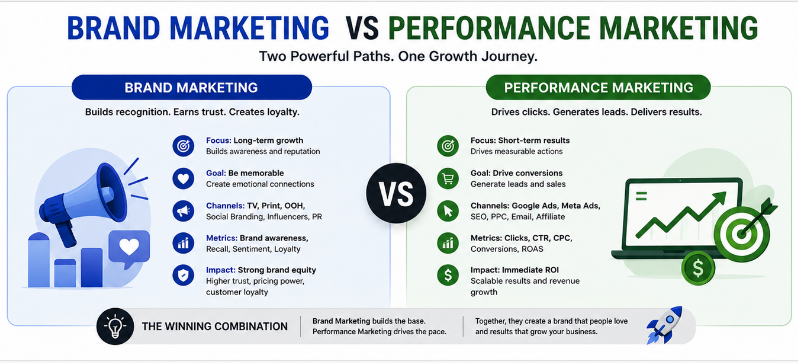
Brand marketing builds awareness, trust, and emotional connection over time. It’s the work that makes people think of you first when they’re finally ready to buy. Think of a memorable ad you still recall years later, a tone of voice that feels distinctly “them,” or a company you’d recommend without being asked.
Brand marketing plays a long game. It rarely produces a sale today. Instead, it plants seeds — shaping how people feel about you so that future buying decisions tilt your way.
What is performance marketing?
Performance marketing drives specific, measurable actions right now: a click, a lead, a purchase. Every campaign ties to a number. You spend a dollar, you track what that dollar returned, and you optimize relentlessly toward better results.
This is the world of paid search, retargeting, conversion-focused landing pages, and ruthless A/B testing. The goal isn’t to be loved — it’s to be effective, fast.
The core distinction
So the heart of brand marketing vs performance marketing comes down to time and intent. Brand marketing creates future demand. Performance marketing captures existing demand. One fills the pipeline of people who will eventually want you. The other converts the people who already do.
Mini-summary: brand builds the want; performance harvests it.
Objectives and Time Horizons: The Real Dividing Line
If you only remember one framework from this entire brand marketing vs performance marketing discussion, make it this one.
Brand marketing thinks in years
Brand investment compounds slowly. A campaign you run this quarter might pay off eighteen months from now, when a prospect finally enters the market and your name is the one they trust. That delay is exactly why brand work is so often underfunded — the payoff is real but patient.
Performance marketing thinks in days and weeks
Performance campaigns deliver fast feedback. You can launch on Monday and know by Friday whether it’s working. That speed makes performance marketing feel safer and more controllable, which is why anxious leadership teams lean on it heavily.
Why the time gap causes conflict
Here’s where the brand marketing vs performance marketing friction really lives. Quarterly targets reward what’s measurable now, so performance wins the budget battle by default. But starve the brand long enough, and your performance campaigns slowly get more expensive — because fewer people recognize or trust you when they click.
Original insight: weak brand quietly inflates your performance costs. You don’t see it on a dashboard, but you pay for it in rising cost-per-acquisition over time.
Metrics: How Each One Proves Its Worth
Metrics are where the two disciplines speak completely different languages, and where the brand marketing vs performance marketing tension gets most heated.
How performance marketing measures success
Performance lives on hard numbers:
- ROAS (return on ad spend)
- CAC (customer acquisition cost)
- Conversion rate
- Cost per lead
- Click-through rate
These are clean, fast, and satisfying. You always know where you stand.
How brand marketing measures success
Brand metrics are slower and softer, but no less real:
- Brand awareness and recall
- Share of voice
- Branded search volume
- Direct traffic growth
- Sentiment and trust
The catch? These don’t fit neatly in a weekly report. A rise in branded search this quarter might trace back to a campaign from two quarters ago.
The attribution trap
This is the most important nuance in the whole brand marketing vs performance marketing debate. Attribution tools are brilliant at tracking the last click — so they hand credit to performance channels. But they’re nearly blind to the brand impressions that made that click happen in the first place.
So performance looks more efficient than it is, and brand looks less effective than it is. Trust the dashboard too literally and you’ll over-invest in harvesting while quietly starving the seeds.
Channels and Creative: Where the Work Lives
The two approaches show up in noticeably different places and look different too.
Typical brand channels
Brand work tends toward broad reach and emotional storytelling: video, connected TV, podcasts, sponsorships, social content that entertains rather than sells, and PR. The aim is memorability, not an immediate click.
Typical performance channels
Performance leans on intent and trackability: paid search, shopping ads, retargeting, paid social with conversion objectives, and affiliate campaigns. Every placement is built to drive a measurable action.
How the creative differs
Brand creative makes you feel something. It’s the heartfelt story, the clever tagline, the visual you remember. Performance creative makes you do something. It’s the sharp offer, the clear benefit, the unmissable call to action.
Example: a running brand might invest in a documentary-style film about marathon runners (brand) while simultaneously running “20% off your first pair, today only” ads to people who already visited the site (performance). Same brand, two completely different jobs.
Audience Targeting: Wide Net vs Sharp Spear
Targeting philosophy is another place the brand marketing vs performance marketing split shows clearly.
Brand marketing casts a wide net. It reaches people who aren’t in the market yet — because today’s casual viewer is next year’s buyer. That breadth feels wasteful to a performance mind, but it’s how you build future demand.
Performance marketing fires a sharp spear. It targets people showing intent right now: searching for your product, abandoning a cart, comparing options. The audience is smaller but far hotter.
Neither is “better.” They’re aimed at different people at different moments in the journey.
Why the Best Companies Reject the Either-Or
Here’s the part too many articles miss. The strongest brands don’t run a brand marketing vs performance marketing contest. They run both, on purpose, as one connected system.
The 60/40 principle
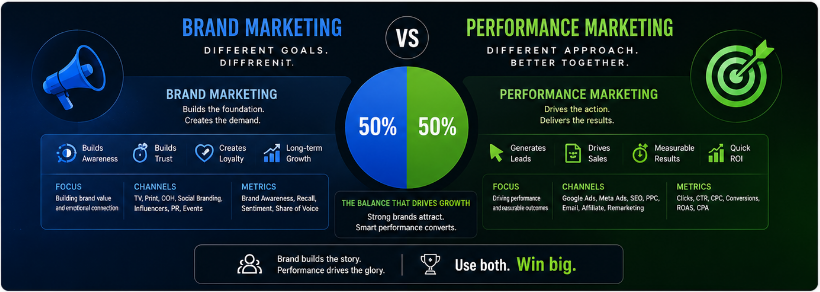
Research into marketing effectiveness has long suggested a rough split of around 60% brand and 40% performance for sustainable growth. The exact ratio shifts by industry and stage, but the lesson holds: lean too far either way and growth suffers.
What happens at the extremes
Go all-in on performance, and you’ll squeeze short-term sales while your brand fades — until your ads get pricier and your pipeline thins. Go all-in on brand, and you’ll build awareness with nothing capturing the demand you created. The brand marketing vs performance marketing balance isn’t a compromise; it’s a flywheel.
How they feed each other
Strong brand work makes performance cheaper and more effective. When people already know and trust you, they click more, convert more, and cost less to acquire. Meanwhile, performance data reveals which messages resonate — insight that sharpens your brand work. Each makes the other better.
Original insight: stop asking “brand or performance?” Start asking “is our brand making our performance cheaper, and is our performance teaching our brand?”
How to Allocate Budget Without Guessing
Theory is nice, but you need a decision. Here’s a practical way through the brand marketing vs performance marketing budget question.
Start with your stage
- Early-stage and unknown? Tilt toward performance to generate proof, revenue, and learnings — but don’t hit zero on brand.
- Established but plateauing? You’re likely over-indexed on performance. Reinvest in brand to refill future demand.
- Strong brand, weak conversion? Shore up your performance and funnel before adding more awareness.
Protect the long-term line
Treat brand spend like R&D, not a discretionary extra. The temptation in tough quarters is to cut it first, because nothing breaks immediately. That’s exactly why it gets cut — and exactly why so many companies end up trapped in expensive, brand-starved performance.
Watch the leading indicators
Track branded search volume and direct traffic alongside ROAS and CAC. When brand investment works, you’ll see those numbers rise and your performance efficiency improve. That’s the brand marketing vs performance marketing system working as one.
Quick tip: if your cost-per-acquisition keeps creeping up no matter how you optimize ads, the problem usually isn’t your ads. It’s a brand that’s gone quiet.
Common Misconceptions Worth Clearing Up
A few myths keep distorting the brand marketing vs performance marketing conversation.
- “Brand marketing can’t be measured.” It can — just not instantly or with last-click tools. Awareness studies, branded search, and share of voice all track it.
- “Performance marketing is cheaper.” Only at first glance. Without brand support, performance costs climb steadily.
- “You should master one before adding the other.” In reality, even small businesses benefit from a little of both from day one.
- “It’s a 50/50 split for everyone.” The right balance depends on your industry, stage, and margins — not a fixed formula.
- “Brand is for big companies only.” A small business with a clear, memorable brand converts better and pays less per click than a faceless competitor.
Frequently Asked Questions
What is the main difference in brand marketing vs performance marketing?
Brand marketing builds long-term awareness and trust to create future demand, while performance marketing drives immediate, measurable actions like clicks and sales. The brand marketing vs performance marketing distinction comes down to time horizon and intent: one fills the pipeline, the other converts it.
Which one should a small business start with?
Most small businesses lean into performance early to generate quick revenue and proof, but ignoring brand entirely is a mistake. Even a modest, consistent brand presence makes your performance campaigns cheaper and more effective over time.
Can brand marketing actually be measured?
Yes, just not with last-click attribution. In the brand marketing vs performance marketing comparison, brand is tracked through awareness studies, branded search volume, direct traffic, and share of voice — slower signals that still prove real impact.
Why does my cost per acquisition keep rising?
Often because your brand has gone quiet. This is the hidden cost in the brand marketing vs performance marketing relationship: when fewer people recognize you, your ads work harder and cost more. Reinvesting in brand frequently brings acquisition costs back down.
Is there an ideal budget split between the two?
A common starting benchmark is roughly 60% brand and 40% performance, but the right brand marketing vs performance marketing ratio depends on your stage, industry, and margins. Use it as a reference point, not a rigid rule.
Do brand and performance marketing really work together?
Absolutely. The whole point of the modern brand marketing vs performance marketing view is that they form one system. Strong brand makes performance cheaper, and performance data sharpens your brand messaging. They compound each other.
Which delivers a faster return?
Performance marketing delivers faster, more visible returns, which is why teams lean on it under pressure. But in the brand marketing vs performance marketing picture, brand delivers the larger, more durable return over time — it just takes patience to see it.
Semantic Keywords Covered
- Brand awareness vs lead generation
- Demand generation
- Direct response marketing
- Growth marketing strategy
- Marketing attribution
- Customer acquisition
- Brand equity
- ROAS
- Long-term vs short-term marketing
- Full-funnel marketing
- Marketing mix
- Cost per acquisition
- Share of voice
- Demand creation vs demand capture
- Branded search
The Bottom Line
The whole brand marketing vs performance marketing debate falls apart the moment you realize it was never a real choice. Brand creates the demand. Performance captures it. Treat them as rivals and you’ll keep robbing one to fund the other — usually starving the brand until your performance quietly gets more expensive.
Here’s what to carry with you:
- Brand builds future demand; performance captures present demand — you need both pipelines flowing
- Don’t trust last-click attribution too literally — it overcredits performance and underrates brand
- Protect brand spend like R&D, especially when budgets tighten
- Watch branded search and direct traffic alongside ROAS and CAC to see the full system working
So the next time someone frames it as brand marketing vs performance marketing, reframe the room. The better question isn’t which one to fund. It’s how to make each one make the other stronger.
Which side has your business been underinvesting in — and what would change if you finally balanced the two?