
Studies on paid search consistently show that businesses waste roughly 25% of their Google Ads budget on clicks that never turn into customers. Think about that. For every $1,000 you spend, $250 could be vanishing into thin air—paying for the wrong searches, the wrong audiences, and clicks that bounce in seconds. A Google Ads optimization service exists to plug that leak and turn your ad spend into measurable returns.
But here’s the catch most agencies won’t tell you: optimization isn’t a one-time fix. It’s an ongoing discipline. And whether you hire help or do it yourself, knowing what actually moves the needle is what separates a profitable campaign from an expensive guess.
Here’s what you’ll discover in this guide:
- What a Google Ads optimization service includes (beyond the buzzwords)
- The six optimization levers that genuinely drive results
- A straight comparison of DIY vs. managed optimization
- The costly mistakes that quietly drain budgets
- A practical framework for choosing the right provider
What Is a Google Ads Optimization Service?
A Google Ads optimization service is a professional offering that continuously refines your paid search campaigns to lower costs, improve ad relevance, and increase conversions. It’s the difference between running ads and running them profitably.
Most people assume optimization just means adjusting bids. It runs much deeper than that. A real service audits your entire account structure, analyzes search term data, rewrites underperforming ads, and aligns your campaigns with what users actually want when they type a query.
Think of it like tuning a race car. The engine (your budget) might be powerful, but without precise tuning—the right tires, fuel mix, and aerodynamics—you’ll never hit top speed. Optimization is that tuning, applied weekly.
What’s Typically Included
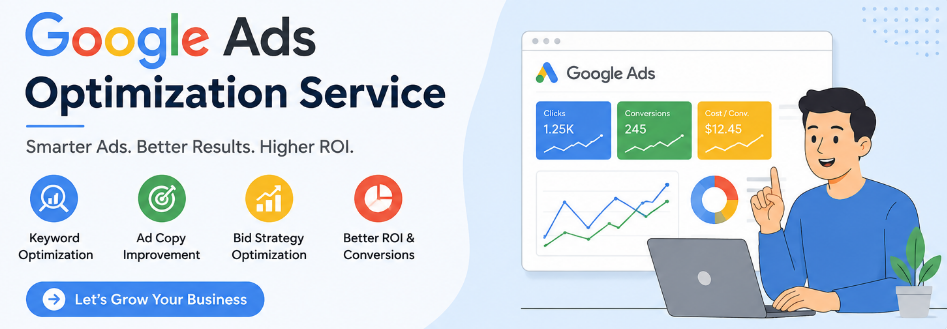
A comprehensive service usually covers a clear set of deliverables:
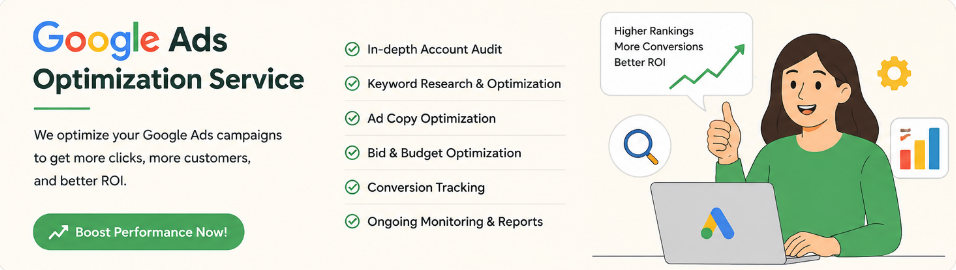
- Account audit: A full review of structure, settings, and historical performance
- Keyword management: Adding high-intent terms and cutting wasteful ones
- Bid strategy adjustments: Matching your bidding model to your goals
- Ad copy testing: Writing and rotating variations to find winners
- Conversion tracking setup: Making sure every lead and sale is measured correctly
- Reporting: Clear, regular updates on what changed and why
Key takeaway: A Google Ads optimization service is ongoing campaign refinement—not a one-time setup—designed to cut waste and lift your return on every dollar.
The 6 Optimization Levers That Actually Drive Results
Not every tweak matters equally. Some changes barely move performance, while others can slash your costs in half. Let’s break down the six levers that genuinely shift outcomes, and how each one works.
1. Quality Score: Your Hidden Discount
Quality Score is Google’s rating of how relevant your keywords, ads, and landing pages are—scored from 1 to 10. It’s arguably the most underrated lever in the entire platform.
Here’s why it matters so much: a higher Quality Score lowers your cost per click and improves your ad position. Google rewards relevance because relevant ads keep users happy Google Ads Optimization Service. In practice, raising a keyword’s Quality Score from 5 to 8 can cut its cost per click by a meaningful margin.
The logic is simple, but the execution takes skill. You improve it by tightening the link between your keyword, your ad text, and the page people land on.
2. Bidding Strategies: Where Goals Meet Math
Your bidding strategy decides how Google spends your budget on each auction Google Ads Optimization Service. Pick the wrong one, and you’ll either overpay or miss valuable clicks entirely.
There’s no universal “best” strategy—it depends on your goal. Here’s a quick read on the main options:
- Maximize Conversions: Great once you have solid conversion data flowing in
- Target CPA (cost per acquisition): Ideal when you know exactly what a lead is worth to you
- Target ROAS (return on ad spend): Best for ecommerce with clear revenue per sale
- Manual CPC: Useful for new accounts where you want tight control before automation takes over
A skilled optimizer doesn’t set one and forget it. They shift strategies as your data matures, because what works at launch rarely works at scale.
3. Ad Copy: The 90 Characters That Decide Everything
Your ad copy is the first impression—and often the only one. Even with perfect targeting, weak copy means wasted impressions.
Strong optimization means constant testing. You write multiple headlines and descriptions, then let real performance data crown the winner Google Ads Optimization Service. The trick is testing one clear idea at a time: a benefit-led headline against a price-led one, or a question against a bold claim.
Up close, the difference is striking. Ads that speak directly to a searcher’s intent—matching their exact problem—routinely outperform generic, feature-stuffed copy.
4. Negative Keywords: The Filter That Saves Budgets
Negative keywords tell Google which searches not to show your ads for. This is where most wasted spend hides, and it’s the first place a good optimizer looks.
Say you sell premium running shoes Google Ads Optimization Service. Without negative keywords, you might pay for clicks on “free running shoes” or “running shoes repair”—searches that will never buy. Adding those as negatives instantly stops the bleed.
It’s no exaggeration to say that a disciplined negative keyword list is one of the fastest ways to recover wasted budget in week one.
5. Landing Pages: Where Clicks Become Customers
You can run flawless ads and still fail if your landing page disappoints. The click is only half the journey—the page has to close the deal.
Optimization here focuses on message match (does the page deliver what the ad promised?), load speed, mobile experience, and a clear call to action Google Ads Optimization Service. A page that takes five seconds to load on a phone will hemorrhage conversions, no matter how good the ad was.
This lever bridges advertising and conversion. It’s also where many businesses lose the most, because they obsess over ads while ignoring the destination.
6. Audience Targeting: Reaching the Right People
Audience targeting layers data onto your campaigns so you reach people most likely to convert. It moves you from “anyone searching” to “the right person searching.”
Modern services use remarketing (re-engaging past visitors), in-market audiences (people actively shopping), and customer match (uploading your own lists) Google Ads Optimization Service. Layering these turns a broad campaign into a precise one.
Key takeaway: The six levers—Quality Score, bidding, ad copy, negative keywords, landing pages, and audience targeting—work together Google Ads Optimization Service. Fix one in isolation and you’ll see small gains; optimize them as a system and results compound.
DIY vs. Managed Optimization: An Honest Comparison
Should you handle Google Ads yourself or hire a service? The honest answer depends on your time, budget, and how much ad spend is on the line Google Ads Optimization Service. When you weigh the real trade-offs side by side, the right choice becomes much clearer.
| Factor | DIY Optimization | Managed Service |
|---|---|---|
| Cost | Only your ad budget, no fees | Ad budget plus management fee |
| Time required | High—often 5–10+ hours weekly | Low—a few hours of oversight |
| Expertise | Self-taught, learning curve | Specialists with cross-account data |
| Speed of results | Slower, trial and error | Faster, based on proven patterns |
| Risk of wasted spend | Higher early on | Lower with experienced hands |
| Best for | Small budgets, learners, hobby projects | Growing budgets, scaling businesses |
Here’s the practical read: if your monthly spend is small and you enjoy learning, DIY teaches you priceless skills. But once your budget climbs past a few thousand a month, the management fee usually pays for itself many times over through recovered waste and better returns.
The logic is simple, but worth stating plainly. A 20% improvement on a $10,000 monthly budget is $2,000 saved—far more than most management fees Google Ads Optimization Service. At that scale, going it alone often costs more than hiring help.
Key takeaway: DIY suits small budgets and curious learners. Managed services earn their keep once spend grows and every wasted dollar stings.
Common Mistakes That Quietly Drain Budgets
After reviewing how campaigns fail, the same costly errors appear again and again. Spotting them is half the battle.
Ignoring Search Term Reports
Your search term report shows the actual queries that triggered your ads—not the keywords you targeted, but what people really typed Google Ads Optimization Service. Skipping this report is like driving with your eyes closed. It’s where wasted spend hides and where new opportunities surface.
Sending All Traffic to the Homepage
A homepage is a jack-of-all-trades, master of none. When every ad dumps users onto it, you force them to hunt for what they wanted. Dedicated landing pages that match the ad’s promise convert far better.
Setting It and Forgetting It
Google Ads is not a slow cooker. Competitors shift bids, seasons change, and what worked last quarter fades. Campaigns left unattended slowly decay, bleeding budget while performance quietly slips.
Chasing Clicks Instead of Conversions
A cheap click means nothing if it never converts. Many businesses celebrate high traffic while ignoring whether those visitors actually become customers Google Ads Optimization Service. Always tie success to conversions and revenue, not vanity metrics.
Neglecting Mobile Experience
A huge share of searches happen on phones. If your ads and pages aren’t built for mobile—fast loading, easy tapping, simple forms—you’re losing the majority of your potential customers before they even engage.
Key takeaway: Most ad waste comes from neglect, not strategy. Regular attention to search terms, landing pages, and conversions prevents slow, silent budget drain.
How to Choose the Right Google Ads Optimization Service
Picking a provider is a high-stakes decision—your budget is in their hands. Yet many businesses choose based on the cheapest quote, then wonder why results disappoint. Here’s a smarter framework.
Look for Transparency First
A trustworthy service shows you exactly what they’re doing and why. Avoid anyone who hides inside a “black box” or won’t explain their changes. You should always have full access to your own account.
Ask directly: Will I own the account? Can I see all changes? How often will we talk?
Demand Clear, Honest Reporting
Good reporting ties activity to outcomes. It shouldn’t drown you in jargon or vanity stats. Look for reports that connect their work to conversions, cost per acquisition, and return on ad spend—the numbers that affect your bottom line.
Check Real Experience and Specialization
Experience across many accounts gives optimizers pattern recognition that no single business can match. Ask about their work in your industry, request case studies, and look for genuine results rather than vague promises.
Watch for Red Flags
A few warning signs should make you pause:
- Guaranteed #1 rankings or specific results—no honest provider can promise this
- Refusing account access—your account should always be yours
- No clear contract or exit terms—you should never feel trapped
- Vague reporting—if you can’t understand it, it’s hiding something
Here are the questions that separate pros from pretenders. Asking them upfront saves painful lessons later.
| Question to Ask | What a Strong Answer Sounds Like | Why It Matters |
|---|---|---|
| Who owns the account? | “You do, fully, always.” | Protects your data and history |
| How do you measure success? | “By your conversions and ROAS, not just clicks.” | Aligns them with your real goals |
| How often do you optimize? | “Weekly reviews, with ongoing adjustments.” | Prevents set-and-forget decay |
| Can I see past results? | “Here are case studies in your sector.” | Proves real, relevant experience |
Key takeaway: Choose on transparency, honest reporting, and proven experience—not the lowest price. The cheapest service often costs the most in wasted spend.
Semantic Keywords for “Google Ads Optimization Service”
If you’re researching or writing about this topic, mapping related keywords helps you cover the full search journey. Here’s how the terms cluster around the primary keyword.
Long-Tail Keywords
Specific phrases that capture clear intent and convert well:
- affordable Google Ads optimization service for small business
- Google Ads optimization service for ecommerce stores
- best Google Ads campaign optimization service near me
- monthly Google Ads management and optimization service
LSI (Latent Semantic Indexing) Keywords
Conceptually linked terms that signal topic depth:
- pay-per-click management
- Quality Score improvement
- conversion rate optimization
- cost per acquisition
- return on ad spend
- search term report
Informational Keywords
Searches from people wanting to learn:
- what is Google Ads optimization
- how to improve Google Ads performance
- why is my Google Ads cost so high
- how does Quality Score work
Navigational Keywords
Searches aimed at a specific tool or destination:
- Google Ads optimization agency
- top PPC management companies
- Google Ads optimization service reviews
- certified Google Ads partner
Transactional Keywords
Phrases signaling readiness to act:
- hire a Google Ads optimization service
- get a free Google Ads audit
- request a PPC optimization quote
- sign up for Google Ads management
Key takeaway: Blending all five keyword types covers every stage of the search journey—from first curiosity to ready-to-buy intent.
Final Thoughts: Optimization Is a Habit, Not a One-Off
A Google Ads optimization service isn’t about a single clever tweak. It’s about consistent, data-driven refinement that compounds over time—plugging waste here, lifting Quality Score there, and steadily turning more of your budget into actual revenue.
The businesses that win with paid search aren’t the ones with the biggest budgets. They’re the ones who treat optimization as an ongoing discipline, watch the right metrics, and either build real expertise or hire people who already have it.
So here’s your next step: pull your search term report this week and scan for wasted spend. If you spot money leaking into irrelevant clicks—and most accounts do—you’ve just found your first opportunity. From there, decide whether to sharpen those skills yourself or bring in a service that lives and breathes this work every day. Either way, the leak stops the moment you start paying attention.