
You have a marketing budget and two giants asking for it. One catches people the moment they search for what you sell. The other puts your brand in front of people while they scroll, laugh, and shop without even meaning to. Both promise sales. Both can drain your wallet fast if you pick wrong.
That’s the real tension behind Google Ads vs Meta Ads. It isn’t about which platform is “better.” It’s about which one fits how your customers actually buy. Get that match right, and your ad spend turns into profit. Get it wrong, and you fund a lot of clicks that go nowhere.
This guide breaks the choice down in plain terms. You’ll see how each works, what they cost, who they reach, and which business types win on each side. By the end, you’ll know exactly where your money should go.
How Each Platform Actually Works
If you want to compare fairly, you need to understand the core difference first. The two platforms catch people at different moments.
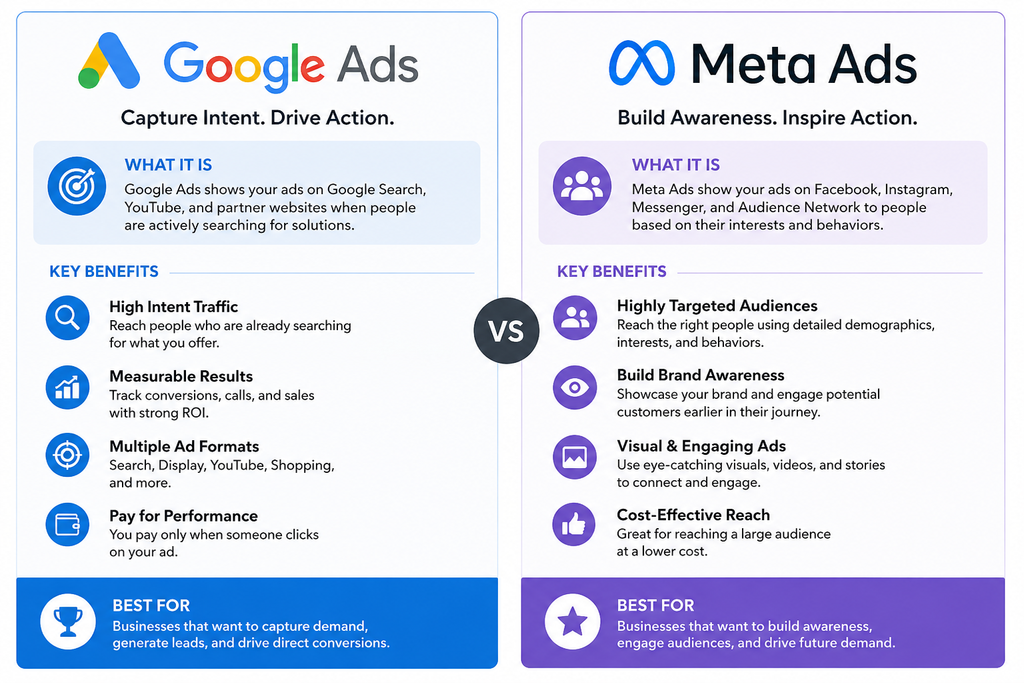
Google Ads runs on intent. Someone types a question or a need into the search bar, and your ad shows up as an answer.
- Search ads appear at the top of search results.
- Display ads show on millions of partner websites.
- Shopping ads put your product image and price right in front of buyers.
- YouTube ads reach people through video.
Meta Ads runs on attention. This covers Facebook Ads and Instagram Ads, plus Messenger and the wider Audience Network.
- Your ad slides into feeds, Stories, and Reels.
- People aren’t searching for you — you interrupt their scroll.
- The platform decides who sees your ad based on behavior and interests.
Here’s the short version of Google Ads vs Meta Ads: Google waits for demand, Meta creates it. That single idea shapes everything else in this comparison.
Intent-Based vs. Interest-Based Advertising
If you want to understand why these platforms perform differently, start here Google Ads vs Meta Ads. This is the heart of the whole debate.
Google is intent-based. People already want something. Your job is to be the answer.
- A person searching “emergency plumber near me” is ready to buy now.
- You catch them at the bottom of the funnel.
- Conversion rate tends to be higher because the desire already exists.
Meta is interest-based. People aren’t looking for you. Your job is to spark a want they didn’t have yet.
- Someone scrolling sees a cool product and thinks, “I didn’t know I needed this.”
- You catch them earlier in the buying journey.
- You build demand instead of capturing it.
This is why the Google Ads vs Meta Ads question rarely has one winner. Search engine marketing closes existing demand. Social media advertising builds new demand. Most strong digital marketing strategy plans use both, just at different stages.
Targeting Capabilities Compared
If you want precise control over who sees your ads, both platforms deliver — but in very different styles.
Google ad targeting is built around what people search and where they go online.
- Keywords: You bid on the exact terms people type.
- Location: Show ads only in the areas you serve.
- Device and time: Target mobile users or specific hours.
- Audience signals: Reach past visitors through remarketing.
Meta audience targeting is built around who people are and what they like.
- Demographics: Age, gender, job title, relationship status.
- Interests: Hobbies, pages liked, brands followed.
- Behaviors: Purchase habits and device use.
- Custom and lookalike audiences: Reach people similar to your best customers.
Honest take: Meta’s audience targeting feels more powerful on paper, but Google’s keyword targeting often converts better. Why? Because someone actively searching tells you exactly what they want. With Meta, you’re making educated guesses about interest. When weighing Google Ads vs Meta Ads on targeting, decide whether you’d rather guess at interest or react to clear intent.
Cost Comparison: CPC, CPM, and Ad Spend
If you want to protect your budget, you need to know what each click and impression really costs Google Ads vs Meta Ads. This is where many small businesses get burned.
Cost per click (CPC)
- Google CPC runs higher on average, often $1 to $4, and far more in competitive niches like law or insurance.
- Meta CPC tends to be lower, often under $1 in many industries.
- You pay more on Google because the traffic is warmer.
Cost per thousand impressions (CPM)
- Meta usually wins on CPM, making it cheaper for brand awareness.
- Google’s display network can also be low-cost for impressions.
- Search ads are not priced for cheap reach — they’re priced for results.
Here’s the trap people fall into with Google Ads vs Meta Ads. They see Meta’s low cost per click and assume it’s the cheaper option. But a cheap click that never buys costs you more than an expensive click that does. Always judge cost against conversions, not against the raw click price.
A few honest notes on ad spend:
- Start small on both before you scale. Test with $20 to $50 a day.
- Cheap clicks mean nothing if your conversion rate stays flat.
- Budget for learning. Your first two weeks are data collection, not profit.
ROI and Conversion Tracking
If you want real answers about performance, you have to track conversions properly. Without tracking, you’re guessing.
Google conversion tracking
- Tracks form fills, calls, purchases, and store visits.
- Ties results directly to search keywords.
- Works well with Google Analytics for a full picture.
Meta conversion tracking
- Uses the Meta Pixel and Conversions API.
- Tracks actions across Facebook Ads and Instagram Ads.
- Faces more limits now due to privacy changes like Apple’s iOS updates.
This matters in the Google Ads vs Meta Ads debate. Privacy rules have made Meta’s tracking less precise than it once was. Google still ties results cleanly to search terms. If you live and die by accurate attribution, that gap is worth weighing.
Practical advice on ROI:
- Define one main conversion before you spend a dollar.
- Set up tracking and test it before launch.
- Give each platform at least 30 days before you judge.
- Compare cost per conversion, not cost per click.
Audience Reach and Scale
If you want sheer reach, both platforms are massive — but they reach people in different headspaces.
Google reach
- Processes billions of searches every day.
- Owns YouTube, the second biggest search engine.
- Reaches people in problem-solving mode.
Meta reach
- Connects billions of users across Facebook and Instagram.
- Keeps people on-platform for long sessions.
- Reaches people in discovery and entertainment mode.
Neither runs short on audience. The Google Ads vs Meta Ads choice here isn’t about size. It’s about mindset. Do you want to reach someone hunting for a solution, or someone open to discovering one?
Ad Formats That Get Results
If you want ads that connect, the format matters as much as the targeting. Each platform plays to different strengths.
Google ad formats
- Search ads: Text-based, direct, built for intent.
- Shopping ads: Product photos with prices for instant comparison.
- Display ads: Banners across websites for visibility and remarketing.
- Video ads: YouTube placements for storytelling and reach.
Meta ad formats
- Image and video ads: The core of feed advertising.
- Carousel ads: Multiple products or features in one swipe.
- Stories and Reels ads: Full-screen, mobile-first, attention-grabbing.
- Collection ads: A mini storefront inside the app.
Quick opinion worth sharing: Meta wins on creative, visual storytelling. Google wins on direct, ready-to-buy moments Google Ads vs Meta Ads. If your product looks great in motion, Meta gives it room to shine. If your product solves an urgent need, Google gets you there faster.
Best Use Cases for Each Platform
If you want a simple rule of thumb, match the platform to your goal. This is where the Google Ads vs Meta Ads decision gets practical.
Choose Google when:
- People already search for what you sell.
- You offer urgent services (plumbing, towing, legal help).
- You want high-intent lead generation.
- You sell products people compare before buying.
Choose Meta when:
- You sell visually appealing products.
- You want to build brand awareness from scratch.
- Your audience doesn’t know they need you yet.
- You want low-cost reach and strong remarketing.
Most businesses shouldn’t treat this as either-or. Use Google to capture demand and Meta to create it. That combination usually beats putting all your budget on one side.
B2B vs. B2C: Which Platform Fits
If you want the platform to match your buyer, your business model points the way.
For B2C advertising:
- Meta often shines with impulse-friendly, visual products.
- Instagram Ads work well for fashion, beauty, food, and home goods.
- Google Shopping captures buyers ready to compare and purchase.
For B2B advertising:
- Google usually wins because buyers search for solutions.
- Search ads catch decision-makers researching tools and services.
- Meta still helps with awareness and retargeting longer sales cycles.
Honest note on B2B vs B2C advertising: B2B buyers research with intent, which favors search engine marketing. B2C buyers respond to inspiration, which favors social media advertising Google Ads vs Meta Ads. Knowing your buyer settles half the Google Ads vs Meta Ads argument before you spend anything.
Remarketing: The Underrated Winner
If you want to squeeze more from your ad spend, remarketing is your best friend on both platforms.
- Google remarketing follows past visitors across the web with display ads.
- Meta remarketing shows ads to people who engaged with your page or site.
- Both turn warm traffic into buyers at a lower cost.
Here’s a strategy most guides skip in the Google Ads vs Meta Ads talk. Run your first touch on one platform, then remarket on the other. Catch someone with a Google search ad, then stay top of mind with Meta. This cross-platform play often beats running each in isolation.
So, Which One Should You Pick?
If you want a straight answer, here it is. The Google Ads vs Meta Ads winner depends entirely on your goal and your customer’s mindset.
- Pick Google for high-intent traffic and faster conversions.
- Pick Meta for visual products, lower-cost reach, and demand building.
- Use both if your budget allows and you want a full-funnel approach.
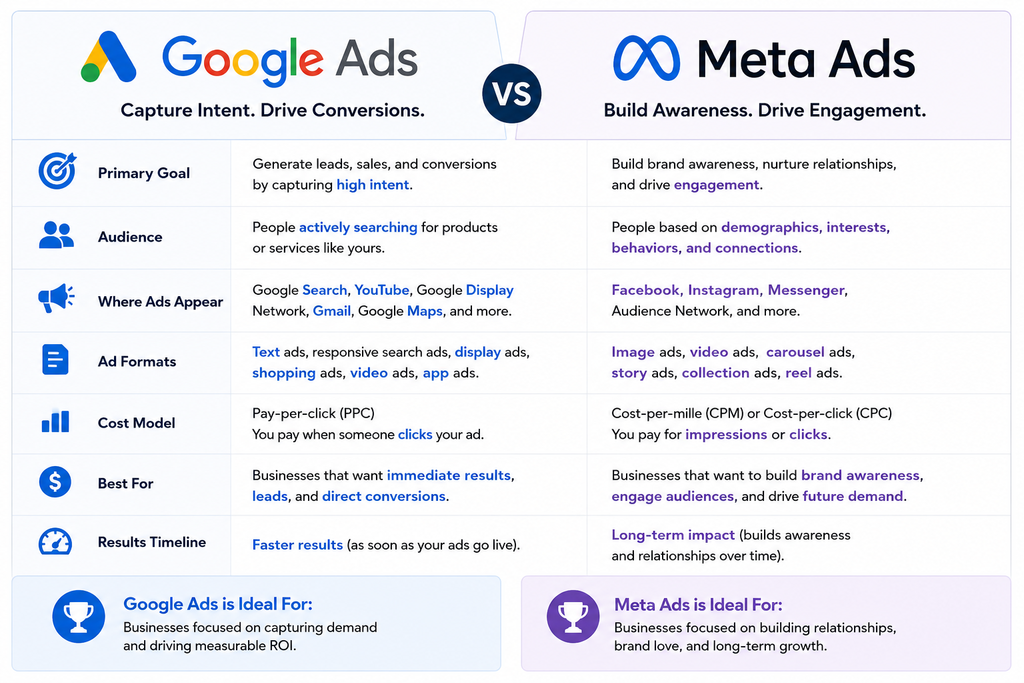
There is no universal champion. The smartest marketers stop asking which platform is better and start asking which platform fits each goal. Run small tests, track your conversions, and let the numbers decide.
Final Thoughts
The Google Ads vs Meta Ads question feels like a battle, but it’s really a balancing act. Google captures people who already want what you offer. Meta introduces you to people before they know they need you. Both have a place in a strong digital marketing strategy.
Keep these decision points clear:
- Match the platform to intent. Search for demand, social for discovery.
- Judge by conversions, not clicks. Cheap traffic that fails is expensive.
- Test before you scale. Let real data guide your budget.
- Use remarketing. It lifts results on both sides.
Start with the platform that matches where your customers are right now. Track everything, learn fast, and shift your ad spend toward whatever earns its keep. That’s how you win the Google Ads vs Meta Ads game — not by picking a side, but by spending smart.
Frequently Asked Questions
Which is cheaper, Google Ads vs Meta Ads?
Meta usually has a lower cost per click and cheaper CPM. But Google often delivers higher-intent traffic, so cheaper isn’t always better value.
Is Google Ads better for small businesses?
It’s great if people search for your service. For local, urgent, or high-intent offers, Google often delivers faster leads.
Can I run Google Ads and Meta Ads together?
Yes, and many businesses should Google Ads vs Meta Ads. Use Google to capture demand and Meta to build it, then remarket across both for the best results.
Which platform has better targeting?
Meta offers deeper interest and demographic targeting. Google offers sharper intent targeting through keywords Google Ads vs Meta Ads. The best choice depends on your goal.
How much should I budget to start?
Start with $20 to $50 a day per platform. Treat your first few weeks as testing, then scale what converts.
Which is better for B2B, Google or Meta?
Google usually wins for B2B because buyers actively search for solutions Google Ads vs Meta Ads. Meta still helps with awareness and remarketing over longer sales cycles.