
You set up a Google Ads account, picked a few keywords, typed in a budget, and waited. A week later you had clicks, a smaller bank balance, and not a single new customer. Sound familiar?
That’s the gap most owners fall into Grow your business with google ads. The platform is easy to start and hard to profit from. The difference between burning cash and steady growth isn’t a secret bidding trick — it’s a structure you can actually repeat.
This guide shows you how to grow your business with Google Ads using a clear, no-fluff system. Here’s what you’ll walk away with:
- Why Google Ads works for real business growth
- Which campaign types fit your goals
- How to budget so you don’t waste a dollar
- A step-by-step plan you can launch this week
Why Google Ads Works for Business Growth
Most advertising interrupts people. Google Ads meets them at the exact moment they want something. That single difference is why so many owners grow their business with Google Ads faster than with any other channel.
Think about the mindset of a searcher. Someone typing “emergency electrician Dallas” isn’t browsing — they’re buying. Paid search advertising puts your offer in front of that person right when their intent is highest. You’re not creating demand. You’re capturing it.
That intent advantage is what makes search engine marketing so reliable. With strong ad targeting and a sensible PPC strategy, you reach people who already decided they need a solution. Your job is simply to be the answer they click.
The math that makes it scalable
Online advertising scales when the numbers work. The formula is simple: if you spend $1 on Google search ads and earn $4 back, you keep buying that $1 all day. That ratio is your return on ad spend (ROAS), and it’s the heartbeat of any paid advertising strategy.
When you grow your business with Google Ads, you’re really building a predictable machine. Put money in, get qualified leads out. Once the conversion rate and cost-per-click stabilize, growth becomes a budget decision, not a guessing game.
Understanding the Main Campaign Types
You can’t grow your business with Google Ads if you pick the wrong campaign for the job. Each type serves a different stage of intent. Here’s how to match them.
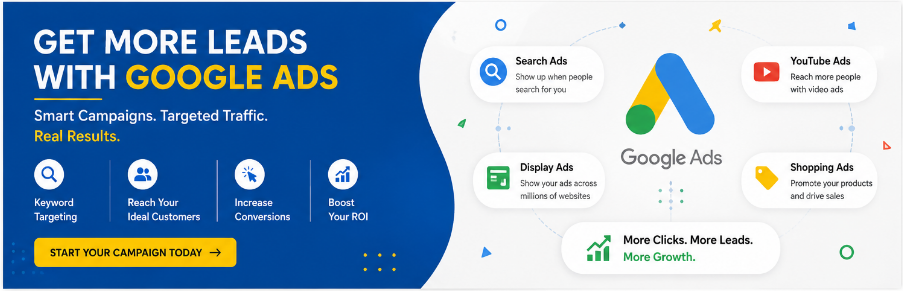
Search campaigns (highest intent)
Search campaigns trigger when people type a query. This is the core of paid search advertising and usually the first place to spend. Strong keyword bidding on high-intent terms delivers the best conversion rate because the demand already exists.
Start here if you sell something people actively search for — services, repairs, software, or local offerings.
Performance Max and Shopping (for products)
Selling physical products? Shopping ads show your item, price, and photo directly in results. Performance Max stretches that reach across Search, YouTube, Gmail, and Display from one campaign. Both lean heavily on Google’s automation, so feed quality and clean conversion tracking matter more than manual keyword bidding.
Display and remarketing (the bridge)
Display ads put visual banners across millions of sites. On their own, they rarely convert cold traffic. But as remarketing — showing ads to people who already visited you — they’re powerful and cheap. This is how you stay in front of warm prospects and lift your overall click-through rate over time.
Video (awareness and recall)
YouTube ads build recognition before the search ever happens. They won’t always show instant returns, but they make your later Grow your business with google ads cheaper because people already know your name. Use video when you want to grow your business with Google Ads over the long term, not just this week.
Setting a Budget That Doesn’t Bleed Money
Budget panic kills more accounts than bad copy ever will. Owners set a number, watch the spend climb, get nervous, and shut it off before the data matures. Let’s fix that.
Start with a number you can test, not survive on
You don’t need a huge budget to grow your business with Google Ads. You need enough to gather data. A practical rule: pick a daily budget that lets you collect at least 15–30 clicks per day on your main keywords. Below that, you’re guessing.
If your cost-per-click is $2 and you want 20 clicks daily, you need roughly $40 a day to learn anything real. Spend less and you’ll wait weeks for signal.
Work backward from a customer’s value
Here’s the question most people skip: what is one customer worth to you? If a new client brings $1,000 over their lifetime and one in five leads converts, you can comfortably pay more per click than a competitor guessing blindly.
This single calculation reshapes your entire paid advertising strategy. It tells you your maximum cost per lead, your target ROAS, and how aggressively you can compete on keyword bidding.
Budget allocation that actually works
- 70% to proven search campaigns with high-intent keywords
- 20% to remarketing for visitors who didn’t convert
- 10% to testing new keywords, audiences, or ad copy
Then let performance move the money. Feed what works, cut what doesn’t. That discipline is how you grow your business with Google Ads without watching spend disappear.
Avoiding the Wasted Ad Spend Trap
Generic guides tell you to “optimize.” Useless advice. Here’s where real money actually leaks in Google Ads management — and how to plug each hole.
Mistake 1: Ignoring the search terms report
Your keywords aren’t the same as what people actually type. A “broad match” keyword can trigger your ad for dozens of irrelevant searches Grow your business with google ads. Check the search terms report weekly and add negative keywords ruthlessly. This habit alone can cut wasted ad spend by 20–30%.
Mistake 2: Sending every click to your homepage
A homepage answers ten questions. A landing page answers one. When you grow your business with Google Ads, every campaign should point to a focused page built for a single action. Mismatched pages tank your conversion rate no matter how good the ad is.
Mistake 3: Skipping conversion tracking
If you can’t see which clicks become customers, you’re flying blind. Without conversion tracking, you’ll optimize toward clicks instead of revenue — and clicks don’t pay your bills. Set this up before you spend a cent.
Mistake 4: Bidding on broad, generic terms too early
A new account bidding on “shoes” or “marketing” will drown. Start narrow and specific. Tight ad targeting on long-tail, high-intent phrases keeps your cost-per-click low and your conversion rate high while you’re still learning.
Mistake 5: Judging too soon
One bad day isn’t a trend. Give campaigns enough clicks and conversions before making cuts. Reacting to noise is how good campaigns die early.
Quick takeaways:
- Audit search terms weekly and add negatives
- Build dedicated landing pages, not homepage links
- Track conversions, not just clicks
- Start specific, expand later
How to Write Ads People Actually Click
Your click-through rate signals whether your message matches the searcher’s need. A higher click-through rate also improves your Quality Score, which lowers your cost-per-click Grow your business with google ads. Better copy literally makes paid search advertising cheaper.
Three rules that work:
- Echo the search. If someone searches “affordable tax software,” your headline should say “affordable tax software.” Relevance wins.
- Lead with the outcome. People click benefits, not features. “Get your taxes filed in 20 minutes” beats “feature-rich tax platform.”
- Add a clear next step. Tell them exactly what happens after the click — “Get a free quote,” “Start your trial,” “Book a call.”
Test two or three versions per ad group and let the data crown a winner. Small copy gains compound across thousands of impressions.
A Step-by-Step Plan to Grow Your Business With Google Ads
Theory is cheap. Here’s a sequence you can run starting today to grow your business with Google Ads the right way.
Step 1 — Define one clear goal
Pick a single outcome: leads, calls, sales, or bookings. Everything — keyword bidding, ad copy, landing pages — bends toward that goal. Trying to do all four at once is how budgets scatter.
Step 2 — Install conversion tracking
Connect your account to your website and define what counts as a conversion. This is non-negotiable. You cannot grow your business with Google Ads if you can’t measure what’s working.
Step 3 — Research high-intent keywords
Use Google’s Keyword Planner to find terms with buying intent. Favor specific, problem-solving phrases over broad ones Grow your business with google ads. Group tight clusters of related keywords into separate ad groups for sharper ad targeting.
Step 4 — Launch a focused search campaign
Start with one search campaign, a handful of ad groups, and 2–3 ads each. Point every ad to a matching landing page. Set a daily budget that buys real data, then leave it alone long enough to learn.
Step 5 — Add negative keywords early
Within the first week, comb the search terms report and block irrelevant queries. This is the fastest way to protect your ad spend and keep your cost-per-click in check.
Step 6 — Turn on remarketing
Once visitors are flowing, launch remarketing to people who didn’t convert. Warm audiences cost less and convert more, lifting your overall return on ad spend.
Step 7 — Optimize on a rhythm
Review weekly. Pause losing ads, scale winners, refine keywords, and tighten landing pages. This steady loop is the real engine behind business growth through ads — small, consistent improvements stacked over months.
Step 8 — Scale what works
When a campaign hits your target ROAS, raise its budget gradually. Scaling a profitable campaign is the simplest way to grow your business with Google Ads. You’re not gambling anymore — you’re buying known results.
When Google Ads Isn’t the Right Move
Honesty matters. You won’t grow your business with Google Ads in every situation.
If nobody searches for what you sell, search campaigns will struggle — you may need demand-generation channels first. If your margins are razor-thin and your customer value is tiny, the cost-per-click math may never work Grow your business with google ads. And if your website converts poorly, fixing that comes before spending on traffic. Sending paid clicks to a broken page just wastes money faster.
Knowing these limits makes your paid advertising strategy stronger, not weaker. Spend where the numbers support you.
Measuring Whether It’s Actually Working
Track these numbers as a system, not in isolation:
- Click-through rate: Is your message matching searcher intent?
- Cost-per-click: Are you paying a fair price for attention?
- Conversion rate: Are clicks turning into customers?
- Cost per acquisition: What does one customer really cost?
- Return on ad spend (ROAS): The bottom line — revenue divided by spend.
Read these together. A high click-through rate with a low conversion rate points to a landing page problem, not an ad problem. Reading the signals correctly is what separates real Grow your business with google ads management from guesswork.
The Bottom Line
You don’t need a massive budget or insider tricks to grow your business with Google Ads. You need intent-matched keywords, tight campaigns, honest tracking, and the discipline to feed winners and cut losers.
Start with one clear goal. Track every conversion. Launch a focused search campaign, block the waste, add remarketing, and optimize on a weekly rhythm. Do that consistently and online advertising stops being a gamble and starts being a growth lever you control.
The owners who win at lead generation aren’t the ones spending the most. They’re the ones running the cleanest system. Build that system, and you’ll grow your business with Google Ads in a way that actually lasts.
Pick your one goal, set up tracking today, and launch your first focused campaign this week — then let the data show you where to grow next.