
You spend money on marketing every month. The reports look busy, the charts go up and to the right, and yet one quiet question keeps nagging at you: what is actually driving results? If you’ve ever felt that uncertainty, you already understand why so many people search for what is performance marketing how it works.
Here’s the good news. There’s a model built entirely around answering that question. It ties spending to outcomes you can see, track, and improve. No more guessing which ad worked or whether your budget paid off.
In this guide, you’ll learn what is performance marketing, how it differs from traditional approaches, the channels involved, and how tracking turns vague effort into clear results. You’ll also pick up the basics of attribution, budgeting, common mistakes, and how to get started. By the end, the whole model should feel far less mysterious and far more useful.
What Performance Marketing Actually Is
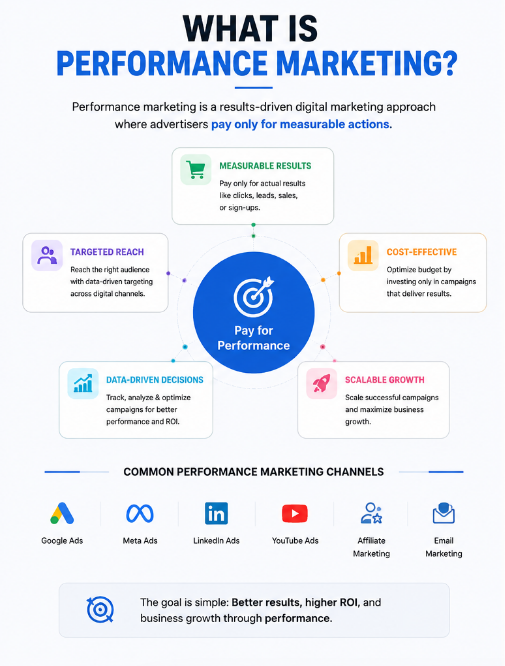
Let’s start simple. What is Performance marketing a results-based approach where you pay for, and measure, specific outcomes rather than vague exposure. Those outcomes might be clicks, leads, sign-ups, or sales. The key idea is accountability: every dollar connects to a measurable action.
That’s the heart of what is performance marketing explained in plain terms. Instead of hoping an ad builds awareness, you track exactly what it produces. This is why people often call it performance based marketing or ROI driven marketing. The focus stays on real, countable results.
Understanding what is performance marketing how it works begins with this mindset shift. You stop asking “did people see my ad?” and start asking “what did my ad actually do?” That single change reshapes how you spend, test, and grow.
Summary: What is Performance marketing pays for and measures specific outcomes, making every dollar accountable.
How It Differs From Traditional Marketing
Traditional marketing leans on broad reach. Think billboards, magazine spreads, or television spots. They build awareness, but proving their direct impact on sales is tricky. You spend first and hope the results follow.
Digital performance marketing flips that logic. Because campaigns run online, nearly every interaction can be tracked. You see which ad drove a click, which click became a lead, and which lead turned into a paying customer. That visibility is what makes it a genuinely measurable marketing strategy.
Awareness vs. Action
Here’s a useful way to picture the difference. Traditional marketing often aims for the top of the funnel, planting a brand in people’s memory. Performance based marketing usually targets action, the moment someone decides to buy, subscribe, or inquire.
Neither approach is “wrong.” But if you want to know what is performance marketing how it works, the answer centers on this: it prioritizes trackable action over unmeasurable impressions. That’s what makes it appealing for businesses watching every dollar.
Summary: Traditional marketing buys reach; what is performance marketing buys measurable action you can prove.
The Key Channels Involved
Performance marketing isn’t a single platform. It’s a collection of channels that share one trait: trackable results. Understanding these channels is a big part of how performance marketing works in practice.
- Paid search: Ads that appear when someone searches for what you offer. They capture existing demand.
- Paid social: Ads on platforms like Instagram, Facebook, or LinkedIn. They create demand and reach specific audiences.
- Display and video: Visual ads across websites and apps that extend reach and support other channels.
- Affiliate marketing: Partners promote your product and earn a commission only when they drive results.
- Email and retargeting: Re-engaging people who already showed interest, often at a lower cost.
Each channel plays a role in paid media performance. A skilled marketer chooses the mix based on where your audience spends time and where conversions actually happen, not on whatever platform is trendy this month.
Choosing the Right Mix
If you’re worried about spreading budget too thin, here’s how to handle it. Start with one or two channels that match your goal. A local service business might begin with paid search. An ecommerce brand discovering new audiences might lean on paid social. Expand only once you see what works.
Summary: What is Performance marketing spans several channels, all chosen for their ability to track real outcomes.
How Tracking and Measurement Work
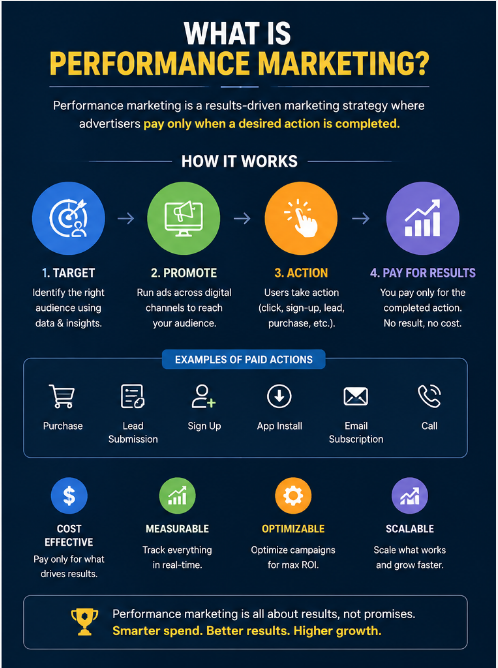
This is where what is performance marketing how it works becomes genuinely powerful. None of it matters without solid measurement. Tracking is the engine that turns activity into insight.
When someone clicks your ad, a tracking system records it. When they take an action, like buying or filling a form, that conversion gets recorded too what is performance marketing. Tools such as analytics platforms and conversion pixels connect those dots, showing you the full journey from ad to outcome.
This is the backbone of data driven advertising. Clean tracking tells you which campaigns produce value and which simply burn money what is performance marketing. Without it, you’re back to guessing, which defeats the entire purpose.
Why Tracking Comes First
Many businesses launch campaigns before setting up proper measurement. That’s a costly order. A performance marketer insists on accurate tracking first, because every later decision depends on it. Get this right, and the rest of the model starts making sense.
Summary: Accurate tracking links spending to outcomes, turning guesswork into reliable insight.
Conversions and Attribution Explained
A conversion is simply the action you want someone to take. A purchase, a sign-up, a download, a phone call. Conversion focused marketing builds every campaign around producing more of these valuable actions efficiently.
Attribution answers a trickier question: which touchpoint deserves credit? Customers rarely buy on the first click. They might see a social ad, search later, read an email, and then purchase days afterward what is performance marketing. Attribution in marketing helps you understand which steps contributed along that path.
Keeping Attribution Useful
Perfect attribution doesn’t exist, and chasing it can drive you mad. The goal is useful, not flawless. A good model shows which channels and campaigns genuinely move the needle, even when the customer journey is messy.
Grasping conversions and attribution is essential to understanding what is performance marketing how it works. Together, they tell you not just that results happened, but where they came from. That clarity guides smarter spending.
Summary: Conversions are the goal; attribution shows which efforts earned them.
Campaign Optimization: The Ongoing Habit
A great campaign is never truly finished. Audiences shift, competitors react, and ad fatigue sets in. This is why campaign optimization is a continuous habit, not a one-time task.
Optimization means testing and refining. You compare headlines, images, audiences, and offers, then double down on winners and cut underperformers. Small improvements stack up over time, and the compounding effect is remarkable.
Testing Without Overreacting
Here’s a common mistake to avoid: reacting to tiny fluctuations. One slow day doesn’t mean a campaign is failing. Good marketers separate genuine signals from random noise, making decisions based on patterns rather than panic.
This steady cycle is central to how performance marketing works. The model improves precisely because it’s built to learn and adjust, month after month.
Summary: Optimization is a constant cycle of testing, learning, and refining for compounding gains.
Budgeting and Spending Smarter
What is Performance marketing doesn’t always mean spending more. Often it means spending smarter. Because results are measurable, you can shift budget toward what works and away from what doesn’t.
Start with a budget you’re comfortable testing, then scale based on evidence. If a campaign returns more than it costs, you have a reason to invest further. If it doesn’t, you pause and learn. This is what makes it true ROI driven marketing.
A practical micro-example: imagine two campaigns. One spends $500 and brings ten customers. Another spends $500 and brings two. Customer acquisition marketing tells you to shift budget toward the first, then test ways to improve the second. The data leads the decision.
Summary: Smart budgeting follows the data, scaling winners and pausing what underperforms.
Common Mistakes to Avoid
Even with a sound model, missteps happen. Knowing them in advance saves money and frustration. Here are the patterns that trip people up most often:
- Unclear goals: Launching without defining success, so nobody can judge results.
- Weak tracking: Running ads before measurement is in place, leaving outcomes invisible.
- Chasing vanity metrics: Celebrating likes or impressions instead of conversions and revenue.
- Giving up too soon: Killing campaigns before they have enough data to prove themselves.
- Ignoring the landing page: Sending great traffic to a weak page that fails to convert.
Avoiding these keeps your spending honest. Understanding what is performance marketing how it works also means understanding what quietly drains a budget. Awareness is half the fix.
Summary: Most failures trace back to unclear goals, poor tracking, or vanity metrics.
Real Use Cases and Examples
Theory only goes so far. Let’s ground what is performance marketing explained in a few practical scenarios.
Ecommerce Growth
An online store wants more sales without wrecking margins. Paid social drives discovery, paid search captures ready buyers, and retargeting nudges window-shoppers back. Every sale is tracked, so the store knows its true return on ad spend.
Lead Generation for Services
A consultancy needs qualified leads, not just clicks. Tight targeting and a strong landing page attract the right prospects. Conversion focused marketing tracks each lead through to closed deals, revealing which campaigns produce real revenue.
Local Business Bookings
A clinic wants more appointments. Paid search reaches people actively looking nearby, and conversions are measured by booking forms and calls. This is what is performance marketing how it works at a local, practical level.
Summary: Across ecommerce, services, and local business, the model proves its value through trackable outcomes.
The Benefits for Businesses
Why does any of this matter for you? The benefits are concrete and worth spelling out.
First, accountability. Every dollar connects to a result, so you finally know what your marketing earns. Second, flexibility what is performance marketing. You can adjust spending quickly based on real data rather than waiting months for a verdict. Third, scalability. Once you find a campaign that works, you can grow it with confidence.
For business owners and managers, this means marketing stops feeling like a gamble. Paid media performance becomes a reliable engine rather than a hopeful expense. That shift, from anxious guessing to grounded planning, is the real prize behind learning what is performance marketing how it works.
Summary: The model delivers accountability, flexibility, and scalable growth you can trust.
How to Get Started
Ready to put this into practice? You don’t need a huge budget or a complex setup to begin. You need clarity and discipline.
- Define your goal. Decide what a meaningful result looks like: a sale, a lead, a sign-up.
- Set up tracking. Make sure conversions are recorded accurately before spending a cent.
- Pick one channel. Choose where your audience already is, then start small.
- Launch and measure. Run a focused campaign and watch what the data tells you.
- Optimize and scale. Improve what works, cut what doesn’t, and grow steadily.
This simple sequence captures how performance marketing works at its core. Start small, measure honestly, and let evidence guide each next move. If the idea of managing it all feels daunting, that’s normal. Many businesses bring in a specialist once they’re ready to scale.
Summary: Begin with clear goals, solid tracking, and one channel, then grow from proven results.
Turning Marketing Into a Measurable Engine
At its best, performance marketing replaces hope with clarity. You know what you spend, you know what it returns, and you can plan with genuine confidence. That’s a world away from pouring money into campaigns and crossing your fingers each month.
Now that you understand what is performance marketing how it works, you can approach your spending with fresh eyes. You can ask sharper questions, demand better tracking, and judge success by outcomes that actually matter to your business.
If you’ve been frustrated by marketing that never quite proved its worth, this model offers a clear path forward. Start small, measure everything, and let the data show you where to grow. Curious to try it? Pick one goal, set up tracking, and launch your first focused campaign. The clarity you gain might just change how you think about marketing for good.