Mobile App Development Company for Your Business
Building an app sounds simple until you're staring at a blank screen wondering where to start. Should you build for iOS or Android first? How much will it cost? Who actually writes the code? These questions stop many great ideas before they ever reach an app store.
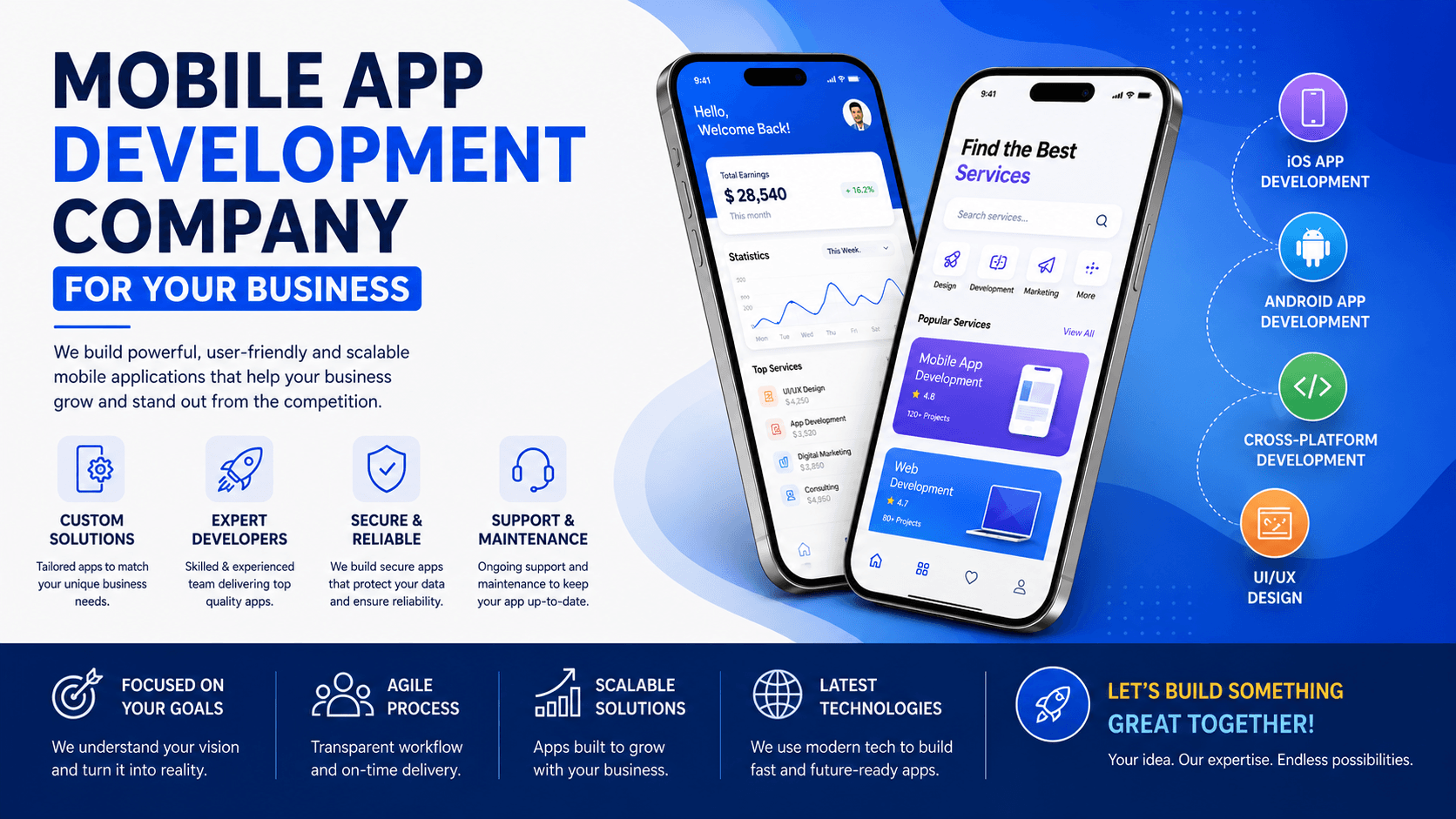
Mobile App Development: The Building Blocks Powering Modern Business
Did you think about the amount of time that is dedicated to or as a result of mobile applications? If we had, we'd be in no position do anything else. The process of securing an alarm and checking weather forecasts, answering to your friends, making an order of coffee, or checking the balance at the bank and a myriad of others, are easy as a single tap, swipe or a scroll. These apps are the most effective and seamlessly integrate into our lives so easily to the point that we don't even realize that they exist.
The impact for businesses that a mobile application has will be the same. It wasn't ever the same. Prior to the advent of mobile apps the hope that customers browse your site or read the emails you sent them was the best method to connect with them. However, the connection was often lost and easily sunk.
What It Takes to Build a Mobile App
The mobile application automatically fits inside the pockets of your clients everywhere they go. If it is designed correctly it can be the most difficult to work for a company. By following the correct approach, you can allow an idea to expand and be successful for a long time.
Why Mobile Apps Dominate Daily Life
Today, more than ever, you are being in contact with your consumers, anticipating their demands and contacting them prior to they are able to compete is more vital than ever. The age of mobile apps has changed the way businesses operate. Today, customers are just simply a tap, click swipe, or scroll away. Connecting with them won't be lost forever and is as vital as the name of your company now.
A mobile app has its own rules, transferring business from their existing spaces into a permanent location on the only device does not leave. According to numerous research studies the majority all of our time spent on screens happens inside apps, not browsers. No longer do we 'visit the web' but instead live within it, effortlessly moving between applications that help and streamline the process of life.
A mobile app can provide many advantages to businesses as it cuts out a variety of the steps. A returning client doesn't have to search for your company or enter your website's URL. Clicking on the app's icon takes customers to your company and is greeted by personalized experience. The push notifications will remind them about the business you run. Additionally, the app will remember the preferences you made last time every time of usage significantly better over the previous.
There's no quantity of money that can be put on the importance of creating a routine among your customers. For business, the word "habit" can be a sign of loyalty.
The Journey From Idea to App Store: The Development Lifecycle
When people think of creating apps, they envision an enormous, complex code session. However, in reality, it's only one element of a more defined process that, when properly executed, will lead to a successful outcome. If you miss a step, your users will be unsatisfied, and the money you spent was wasted.
Discovery: The Power of Asking the Difficult Questions First
The key to a successful development of an app is a person who has the ability to ask smart questions prior to laying out code or designs are created. Who are the users? What is the app's contribution to providing an alternative to other solutions that address one issue? What will the app's performance be measured in terms of objectives?
In a similar way, discovering is making a list of places you'd like to see while on the road prior to leaving. Although for the elated founder this procedure may be a little boring, you'll end up happy later, as every minute invested in this process can save you 10 hours in the form of unneeded time. Your best development partners will advise you that this phase is vital and shouldn't be missed.
Design: Ideas Take Shape
Ideas begin to take form in the visual world. Idea development is initiated by the designers who create wireframes. Wireframes eventually are augmented by high-quality mockups as well as prototypes that can be interactive. It is the first time your concept will take actual shape.
Prototyping can be a great way to ensure that you can test the feasibility of your design. The most awkward or uninspiring prototypes will never come as a cost-effective surprises. Changes to design that are major after prototyping are easy and easy.
Engineering: The Art of Coding
The best engineers can improve the designs they're asked to develop by writing amazing codes. Engineering encompasses far more than functionalities. It's about creating systems that can adapt to future developments through inviting them, rather than restraining the changes.
The most effective teams for system development develop in iterations, which usually are only for a couple of weeks. This lets you gradually develop an application instead of waiting at least a year for the finished version.
Testing: Break It, If Only to Fix It
Programmers who write code for fun try to hope for the most effective. Professional teams evaluate their applications thoroughly to find glitches, bugs, or user interfaces that are poorly thought out and fix the app before a real live user encounters the application.
It is not possible to sell a car without testing driving it and making sure that the brakes are working correctly, so why offer an app without testing. The application that has the highest rating in market may not be able to fulfill the purpose for which it was created at its purposeful moment.
Launch: Start Not Finish
Complying with the requirements of a store listing can be perhaps the most demanding and labor-intensive part in launching an application. Experienced developers be aware of the prerequisites and the way each platform for listing stores examines the application to ensure that it is not rejected. an application disqualified.
The debut of the application at a retail store is the first step towards the actual applications' use around the world. This is regarded as the very first purchase.
Native or Cross-Platform? Your Choice
This choice affects a variety of things including the price of the application, its schedule and the way that an application will feel.
The Native Approach
Native Development describes building an application that uses the Language specific for each Platform. Making an application to run on Apple devices could necessitate the use of Language Swift, while building apps for devices running Android could need using Kotlin. Imagine that a tailor cuts an individual suit. It will be perfect for the person wearing it.
Native applications appear to be the most swift and fluid when communicating with devices. Native applications can access a device's hardware and options with no translation layer that is, they can interact with each possibility and every sensor with the speediest possible speed. The expense and time required for developing an application that uses native methods is huge. However, the tradeoff is that you build two apps that need to be updated simultaneously.
If your application needs an extremely high level of performance, plenty of graphics or a large amount of interaction with a device's hardware, then a Native development method could be worth the price.
The Cross-Platform Approach
The development process using a cross-platform framework is similar to making use of React Native or Flutter.Write code one time and then have your applications that run across Apple devices as well as Android devices. Instead of modeling 2 outfits which are designed to suit two distinct people, make one model that will fit two persons quite well.
The cross-platform approach is an excellent option as it's more efficient, and you only have to use only one base of code, and the application available on both stores. The majority of users are unable to tell what is different between applications developed by different frameworks because they've all risen in capability to provide quality apps.
If you are a business with a small budget who wish to try the waters of app development Cross-platform development is the method which offers the most worth. It's less important than having a clear idea of what you'd want to accomplish This is the reason the best partner will assist you in weighing your options rather than promoting the most popular software.
UI/UX: The Invisible Craft That Decides Everything
It's likely that you've erased an application at one time or another. The app was perhaps clunky or difficult to use or. There could be tiny, hard-to-click buttons. You might have trouble figuring out how to accomplish the thing that you had opened to accomplish. Whatever the reason, you quit the app, and probably did not return.
That's the reality behind users' experience. The majority of people do not appreciate great design. However, bad design is easy to recognize, and it generally gets harshly criticized.
Designing for the Thumb, Not the Mouse
Mobile designs break the norms of desktop design. Fingers may not be as precise like mice are. The design process for mobile devices is to create to fit one hand while also accommodating users who are using their mobile device outdoors under intense sunlight or even at night when they have fatigued eyes. Designers who are good at their craft have of these cases for edge protection in the back of their minds. They ensure that text remains legible and adhere to other design concepts.
Simplicity as a Discipline
The need to load the app with each and every features is highly appealing. Design teams are an effective way of preventing this. An app with a strong foundation that can complete three things beats an app struggling to perform 20 jobs. Subtraction of features is extremely difficult. UX is not a form of applicative fluff. This is the reason why certain applications for mobile are adored and why others are embraced while others are being discarded.
Modern Trends Reshaping What Apps Can Do
Mobile technology in general does not stand still. Certain factors will alter what people expect to see to see as the minimum requirements from an excellent mobile application.
Artificial Intelligence That Feels Personal AI
AI has evolved from an over-hyped buzzword to an enthralling technology. Applications now use AI to help with behavior prediction as well as recommendation. An app for shopping that is personalized and a fitness application that is tailored to your needs and a finance application that alerts users to suspicious spending trends in AI developed applications.
Interest was generated by the development of AI within the world of business. AI can alter the experience of consumers up to a whole new standard. Apps for wellness that offer personal suggestions and shopping apps which reflect the preferences of the user and predictions of behavior blur the lines between an app for recommendations and an app that is a partner.
Everything Connected to Everything
The applications have also entered into alliances and integrate with payment systems, smart devices systems and various other technological. An application that is fully functional adapts to the changing world of connectivity, whereas poor integration of applications can create communication gaps. Connected world is an expectation, and the expectations for it are higher.
The Trust You Can't Afford to Lose
When downloading an application, users provide sensitive data like their preferences as well as conversations and financial details. This information can be a huge confidence that customers replenish each when they download an app.
It is a bond of trust that cannot be broken and should not be added to later. Security is built in to the very first line of code through encryption of sensitive information, handling data for logins, ensuring that the your software is always up-to-date and also recognizing an application that safeguards the users who use an application.
The repercussions of doing this wrong can be devastating. Just one security breach could be enough to damage the trust of clients for good. The years of goodwill built up over time can be lost in just one paper. Security breaches can be a moral and wise business choice taking security seriously and making it essential should be among the main pillars of enterprise.
Post-Launch Support: The Part Too Many Forget
There are some things that developers must discover the hard way when making and launching their app for the very first time. One of these is that a program cannot be perfect. It is a fact that it's only the beginning of an extensive and difficult trip.
The latest hardware and software compete for attention of your users. Recent feature requests as well as bugs alter the of the game. Don't be too slack in an application and something that once worked won't function in any way.
Updates to security and the latest features are only a few aspects you'll want to keep up-to-date even after the app has launched. The partner you have chosen to work with is there and dedicated to your app as well as your needs for business. The ongoing involvement of your partner ensures your app will remain effective and useful. A successful app's performance is judged by the longevity and quality of partnerships that are formed. not by the very first purchase done.
Apps you enjoy the most did not come out perfect when they initially released. The consistency and willingness to correct any issues makes the application better...and enjoyed.
An App as a Growth Engine, Not a Cost
You should ask yourself the more important issue. What are the goals of making a mobile-friendly application? This is a chance to create a customer engagement platform that's efficient as well as simple and effective to your company.
An application that is mobile has the potential to increase customers' loyalty. Additionally, it has the capacity to generate revenue via subscriptions, purchases, and more customer engagement. The insights gained are utilized to analyze the way in which your product is utilized and then take action to make improvements. Redesigning your mobile application can help to improve the performance of your company and give the impression of being trusted.
It's not an accident that businesses with a successful track record invest in the highest quality of craftsmanship to differentiate their mobile applications from competitors. This competitive advantage comes from the numerous subconscious and hidden decisions taken to enhance user experience.
If you're trying to justify your investment, don't think of the mobile app as a expense that you must to justify. Imagine a mobile application as an investment which each day fulfills your purpose in fostering customer loyalty and engagement, and, in turn, generates income.
Turning Your Idea Into Reality
Rewind to those moments in your life before you put in the effort building your mobile app. These moments could include placing a ordering of coffee or checking the balance of your bank account and sending out a text or a text message. Every one of those occasions are created to make your life even better. Customers also deserve to be treated with exactly the same.
Making great mobile applications is a combination of scientific and artistic thinking, sense and purpose, as well as determination and discipline. A great mobile application design includes careful design, honest exploration and a clean, efficient engineering. It withstands the rigors of testing and growing even after the launch. Make the right choice regardless of whether it's hybrid or cross-platform and focus on your user experience. Make sure you protect your user's faith as if it was your most precious possession.
Consider who is on the other end of your mobile app's user interface. Imagine for a second the person who is tapping on your application's icon. Make sure you develop your mobile app with care Find a similar developer, and be sure you keep a top quality.
If you follow the steps above it's not just about creating an app, but you'll also create something that your customers can't resist engaging with on a regular basis This is the place where genuine user interaction is created.